
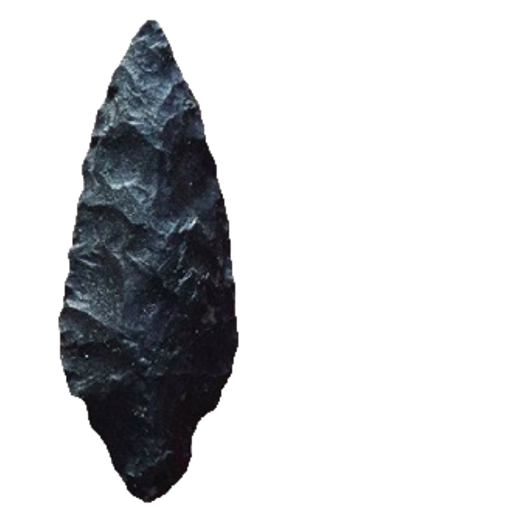
Arrowhead type
Cascade Shouldered Point
Cascade Shouldered8,000 - 5,000 B.P.Early Archaic to Middle Archaic10 reference photos
Key facts
- Age
- 8,000 - 5,000 B.P.
- Cultural period
- Early Archaic to Middle Archaic
- Culture
- Old Cordilleran Culture
- Size
- Medium to Large
- Shape
- Contracting Stem to Ovoid
- Material
- Obsidian
- Glacial period
- Middle Holocene
More from the Archaic period
Description
This lanceolate point exhibits a distinctive elliptical profile, with a medium to large size range. Its blade features a pronounced excurvate shape, often accompanied by delicate serrations along its edges. The shoulders are either faintly defined or nonexistent, positioned at an upward inclination. The stem tapers inward, terminating in a convex base. Notably, the area intended for hafting typically lacks evidence of grinding. The flaking pattern on this point varies, spanning from parallel oblique to random arrangements, showcasing a range of flaking techniques.
Size
The dimensions of the arrowheads are characterized by the following measurements: overall length ranges from 25mm to 145mm, with a typical range of 45mm to 70mm. The width of the blade spans from 11mm to 35mm, averaging between 20mm and 25mm. In terms of thickness, the arrowheads measure between 3mm and 9mm.
Distribution
This type is mainly located in the Columbia Plateau region of Washington and Oregon, extending into northern Idaho and western Montana. It is also discovered throughout the Cascade Mountains and into the northern Sierra Nevada mountains of California and Nevada. Additionally, it can be discovered in the Okanagan Mountains of British Columbia, reaching as far as the coastal areas
Mainly found in
Additional information
In the realm of Native American arrowheads, the Cascade Shouldered type bears a notable resemblance to the Mahkin Shouldered Lanceolate type. However, a key distinction lies in the presence or absence of basal grinding. The Mahkin type is characterized by the presence of grinding in both the basal and hafting regions, which serves as a distinctive feature of this particular style. In contrast, the Cascade Shouldered type lacks basal grinding, setting it apart from its Mahkin counterpart. This subtle yet significant difference highlights the importance of meticulous examination and attention to detail in the classification and identification of arrowhead types. By recognizing these nuances, archaeologists can gain a deeper understanding of the cultural and technological contexts in which these artifacts were created.
Identified by
- Named by
- B. Robert Butler
- Year
- 1961
Similar types
Types that are easy to confuse with the Cascade Shouldered point.
Other types in this cluster
- Cascade
- Cascade Bi-Point
- Cascade Knife
- Mahkin Shouldered Lanceolate