
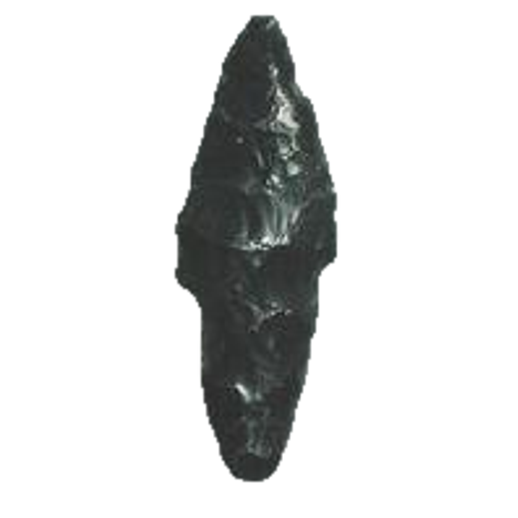
Arrowhead type
Parman Point
ParmanNorthern Pacific Stemmed Cluster10,000 - 9,000 B.P.Early Archaic17 reference photos
Key facts
- Age
- 10,000 - 9,000 B.P.
- Cultural period
- Early Archaic
- Culture
- Nenana Complex
- Size
- Medium to Large
- Shape
- Straight Stem to Contracting Stem
- Glacial period
- Early Holocene
More from the Archaic period
Description
This stemmed point exhibits a distinctive triangular to lanceolate shape, characterized by an elliptical cross-sectional profile. The blade's curvature can range from a pronounced excurvate shape to a straight edge. The shoulders are typically subdued and inclined upwards, although their orientation can vary from this upward angle to a more horizontal position. The stem is notably elongated and tapers slightly, terminating in a base that is either straight or subtly convex. The flaking pattern observed on this point is random, lacking a discernible or consistent pattern.
Size
The dimensions of the arrowheads are as follows: overall length ranges from 43 to 165 mm, with a typical average length of 50 to 70 mm. The stem measures between 23 and 38 mm in length. In terms of width, the blade spans 18 to 39 mm, while the stem width at the shoulder joint varies from 13 to 34 mm.
Distribution
This type is mainly discovered in the northern Great Basin and the Columbia Plateau region.
Mainly found in
Additional information
In the realm of Native American archaeology, a particular series of arrowhead types has garnered significant attention. This series encompasses a range of points, notably including the Lake Mohave and Silver Lake varieties. Noteworthy is the suggestion that the Lind Coulee point and this series type may, in fact, represent a single type, with size being the primary distinguishing factor. Furthermore, research implies that the Lake Mohave and Silver Lake points may be culturally and typologically analogous to the Parman and Lind Coulee points, with the primary difference being their geographic distribution, which tends to be more southern in nature.
The classification of these arrowhead types as a series rather than distinct, unique types underscores the complexities and nuances of Native American archaeological record. The Lake Mohave and Silver Lake points, in particular, exhibit characteristics that warrant their inclusion within this broader series. By examining the morphological and distributional patterns of these points, archaeologists can gain valuable insights into the cultural and technological developments of the Native American groups that crafted them.
The observation that size differences may be the primary factor separating the Lind Coulee point from this series type highlights the importance of careful analysis and consideration of multiple factors in archaeological classification. Similarly, the proposed equivalence between the Lake Mohave, Silver Lake, Parman, and Lind Coulee points, with the caveat of geographic distribution, serves as a testament to the dynamic and interconnected nature of Native American cultural expression. As researchers continue to study and refine our understanding of these arrowhead types, a more comprehensive picture of the technological, cultural, and historical contexts in which they were created will emerge.
Identified by
- Named by
- Thomas M. Layton
- Year
- 1970
Similar types
Types that are easy to confuse with the Parman point.