
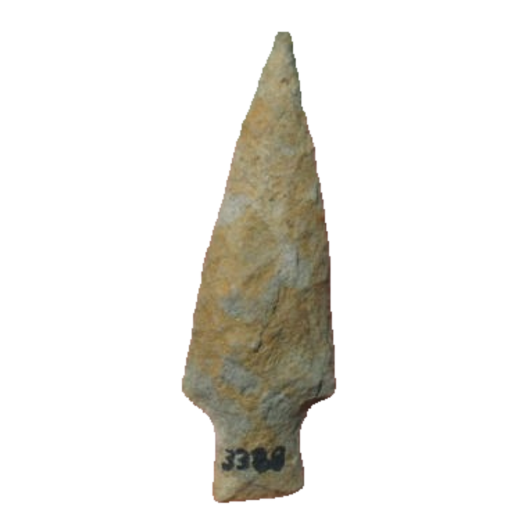
Arrowhead type
Lackawaxen Point
LackawaxenLamoka Cluster6,000 - 4,000 B.P.Middle ArchaicKey facts
- Age
- 6,000 - 4,000 B.P.
- Cultural period
- Middle Archaic
- Size
- Medium to Large
- Shape
- Expanding Stem to Straight Stem
- Material
- Quartz
- Glacial period
- Middle Holocene
More from the Archaic period
Description
This triangular point exhibits a medium to large size profile, characterized by a stem that displays variability in its morphology, ranging from a contracting to an expanding form. The blade itself is elongated and slender, with a shape that can be either straight or subtly excurvate. The shoulders of the point are understated and can assume a range of orientations, from a horizontal alignment to a more angled, upward inclination. The stem's cross-sectional shape can be contracting, parallel, or expanding, while the base of the point presents a subtle curvature, oscillating between a slightly convex and a slightly concave profile. Notably, the manufacture of this point often appears somewhat rough-hewn, with a flaking pattern that is random and unstructured, lacking a deliberate or systematic approach to the removal of flakes.
Size
The dimensions of the arrowheads are characterized by the following measurements: length ranges from 35 to 110 mm, with a mean length of 62 mm. The stem length is between 10 and 15 mm. In terms of width, the arrowheads measure between 17 and 28 mm, averaging 22 mm. The stem width varies from 8 to 15 mm, and the thickness ranges from 6 to 12 mm, with an average thickness of 8 mm, as reported by Kinsey (1972) and Kraft (1975).
Distribution
These artifacts occur from northern Virginia, spanning the Potomac River Basin and extending into the Susquehanna River basin. They are distributed throughout the Hudson River basin and into the White Clay Creek and Brandywine river basins of Delaware.
Additional information
In the realm of Native American archaeology, the Bare Island and Lackawaxen point types are often regarded as contemporaneous, collectively referred to as Bare Island/Lackawaxen points. A notable distinction between these two types lies in the primary materials utilized in their construction. The Lackawaxen type is predominantly crafted from argillaceous shale, whereas the Poplar Island type, often mentioned in conjunction with these point types, typically employs quartz and quartzite. The choice of material may have significant implications for the point's morphology, as argillaceous shale is prone to weathering, which can lead to a reduction in the blade and shoulder areas over time. In contrast, quartz, being more resistant to weathering, tends to preserve the shoulder structure, resulting in more pronounced shoulders.
The observations of Kinsey (1959) highlight the importance of shoulder morphology in distinguishing between the Bare Island and Lackawaxen types. According to Kinsey, the presence of strong shoulders is a defining characteristic of the Bare Island type. This distinction may be attributed to the differential weathering rates of the materials used, with argillaceous shale-based points, like those of the Lackawaxen type, exhibiting more pronounced wear and tear, thereby reducing the shoulder area. In contrast, points crafted from more durable materials, such as quartz, are more likely to retain their shoulder structure, resulting in the strong shoulders that Kinsey identified as a hallmark of the Bare Island type.
The consideration of material properties and their impact on point morphology offers valuable insights into the technological and cultural practices of Native American groups. The consideration of these factors can inform our understanding of the historical context in which these points were created and used, highlighting the complex interplay between material choice, environmental factors, and cultural expression. By examining the characteristics of these point types, researchers can gain a deeper appreciation for the ingenuity and adaptability of Native American communities, as well as the significance of these artifacts in the broader narrative of American archaeological history.
Identified by
- Named by
- Fred Kinsey and Vernon Leslie
- Year
- 1959
- Type site
- Kent Halley Site, Lower Susquehanna River Valley
Similar types
Types that are easy to confuse with the Lackawaxen point.
- Bare Island
- Duncan's Island
- Lagoon
- Neville
- Normanskill
- Piedmont
- Poplar Island
- Taconic Stemmed
- Tock's Island