
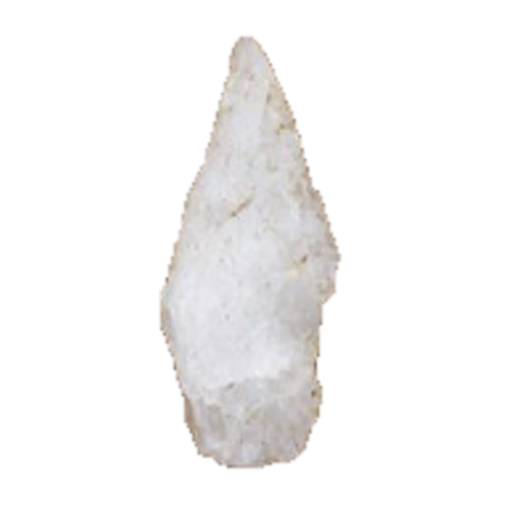
Arrowhead type
Wading River Point
Wading RiverLamoka Cluster4,000 - 1,500 B.P.Late Archaic to Early WoodlandKey facts
- Age
- 4,000 - 1,500 B.P.
- Cultural period
- Late Archaic to Early Woodland
- Size
- Small
- Shape
- Straight Stem to Expanding Stem to Contracting Stem to Ovoid
- Glacial period
- Neoglacial to Roman Warm
Description
This triangular point features a sturdy, compact design with an elliptical profile. The blade edge exhibits variability, ranging from a pronounced excurvate curve to a straight alignment. Characteristically, the shoulders are subdued and inclined upward, forming a subtle angle. The stem, straight in orientation, is defined by parallel margins. The basal edge displays diversity, oscillating between a straight and convex configuration. Notably, the base of this point remains unground, lacking any evidence of intentional basal grinding. The flaking pattern present on this artifact is random, devoid of any discernible order or consistency.
Size
The dimensions of the arrowheads are characterized by the following measurements: overall length ranges from 28 to 38 mm, with a mean length of 32 mm. The stem, which constitutes approximately one-third to one-half of the total length, measures between 8 and 12 mm. The blade exhibits a width of 10 to 18 mm, averaging 15 mm, while the stem width varies from 8 to 12 mm, with an average of 10 mm.
Distribution
These artifacts are located throughout the White Clay Creek and Brandywine river basins of Delaware and adjacent regions
Mainly found in
Additional information
In the realm of Native American archaeology, the classification of a particular cluster of arrowheads has been a subject of interest among researchers. Notably, the University of Minnesota categorizes this group as a Durst Stemmed cluster, whereas Justice, in his 1987 publication, refers to it as the Lamoka cluster. For the purposes of this discussion, we will adopt the latter designation, as seen in our current classification.
Further examination of these artifacts reveals intriguing insights. Fogelman, in his 1988 study, proposes that certain specimens within this cluster may be re-sharpened Duncan Island points, highlighting the resourcefulness and adaptability of the indigenous cultures that created them. Meanwhile, Custer's 1996 research suggests a potential chronological distinction within the cluster, with larger points potentially predating their smaller counterparts. However, it is essential to note that some of the smaller points may be more accurately classified as Wading River points, as distinguished by Ebright in 1992. A key characteristic of Wading River points is their relatively smaller size, often accompanied by a lack of basal grinding, which serves as a diagnostic feature to differentiate them from other types within the Lamoka cluster.
The variations within the Lamoka cluster underscore the complexity and nuance of Native American archaeological record. As researchers, it is crucial to consider the multiple perspectives and classifications that have been proposed, as each contributes to a deeper understanding of the cultural and historical contexts in which these artifacts were created. By examining the characteristics, such as size and basal grinding, and considering the findings of scholars like Custer and Ebright, we can gain a more comprehensive appreciation for the craftsmanship, traditions, and technological adaptations of the indigenous peoples who fashioned these arrowheads.
Identified by
- Named by
- William A. Richie
- Year
- 1965
Similar types
Types that are easy to confuse with the Wading River point.
- Duncan's Island
- Lackawaxen
- Neville
- Piedmont
- Piney Island
- Poplar Island
- Sylvan Lake