
Arrowhead type
Lamoka Point
LamokaLamoka Cluster5,500 - 3,500 B.P.Middle Archaic to Late Archaic17 reference photos
Key facts
- Age
- 5,500 - 3,500 B.P.
- Cultural period
- Middle Archaic to Late Archaic
- Culture
- Laurentian Tradition
- Size
- Small to Medium
- Shape
- Straight Stem to Expanding Stem to Side Notch
- Material
- Quartzite
- Glacial period
- Middle Holocene to Neoglacial
More from the Archaic period
Description
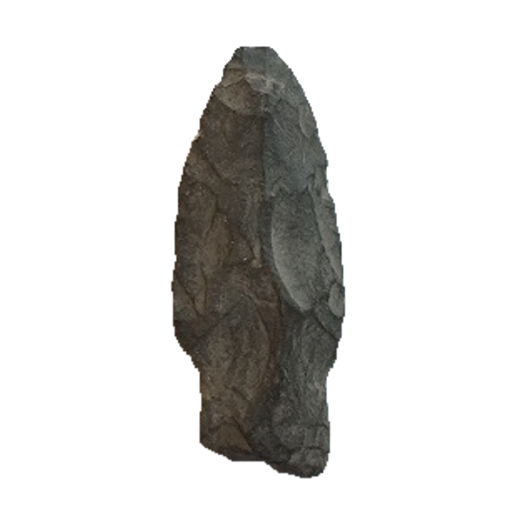
This triangular stemmed point exhibits a moderate thickness and an elliptical profile. The blade's curvature is predominantly excurvate, although some specimens display a straighter blade morphology. The shoulders are often subdued, sloping upward in a gentle incline, while others feature more pronounced, horizontally oriented shoulders. The stem typically presents a straight configuration, but can also exhibit an expanding form. The basal edge varies in shape, ranging from straight to convex, and is characteristically left unfinished, serving as a distinctive diagnostic trait for this point type. The flaking pattern on this point is random, lacking a discernible order or orientation.
Size
The dimensions of the arrowheads are as follows: they typically range in length from 25 to 65 mm, with an average length of 40 mm. The stem measures between 7 and 12 mm in length, while the blade width varies from 12 to 19 mm. The width of the stem is between 7 and 12 mm, and the overall thickness of the arrowhead ranges from 5 to 9 mm.
Distribution
This type is mainly discovered from New York into the Ohio River valley and the Niagara Peninsula in Ontario.
Mainly found in
Also found, less often, in
Additional information
In the realm of Native American arrowheads, a distinct cluster of points has been identified, characterized by their smaller, cruder, and thicker morphology. The manufacturing technique employed in the creation of these points involves soft percussion flaking, with minimal or no pressure flaking. Notably, the University of Minnesota refers to this cluster as the Durst Stemmed cluster, whereas Justice (1987) categorizes it as the Lamoka cluster. For the purposes of this discussion, we will adopt the latter designation, acknowledging that the Durst Stemmed, Dustin, and Lamoka points are, in fact, the same type, with nomenclatural variations reflecting their geographic distribution.
The distribution of these points is a significant factor in their designation, with the Lamoka point being the preferred term in northern Ohio and eastern regions, while the Dustin point is commonly used in the Michigan area, and the Durst Stemmed point is applied in northern Illinois and eastern areas (W2 / Justice 1987). It is essential to recognize that these points are listed separately to provide a detailed account of their naming conventions and geographic ranges, ultimately facilitating more accurate regional identifications. By acknowledging these subtle distinctions, researchers can better understand the complexities of Native American arrowhead typology and the cultural contexts in which they were created.
The Lamoka cluster, as we will refer to it, exhibits a unique combination of characteristics that set it apart from other point types. The use of soft percussion flaking, resulting in a thicker and cruder point, suggests a specific technological approach that may be indicative of the cultural and temporal context in which these points were produced. Further study of the Lamoka cluster can provide valuable insights into the lives and traditions of the Native American groups that created these arrowheads, highlighting the importance of continued research and analysis in the field of archaeology.
Identified by
- Named by
- William A. Ritchie
- Year
- 1961
- Type site
- New York
Similar types
Types that are easy to confuse with the Lamoka point.
- Bradley Spike
- Dewart
- Duncan's Island
- Kramer
- Lagoon
- Newmanstown
- Piney Island
- Rheems Creek
- Schuylkill
- Sylvan Lake
- Squibnocket