
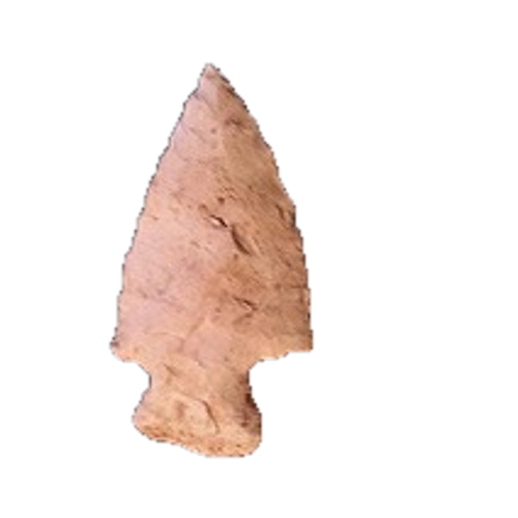
Arrowhead type
Dustin Point
DustinLamoka Cluster5,500 - 3,500 B.P.Middle to Late Archaic5 reference photos
Key facts
- Age
- 5,500 - 3,500 B.P.
- Cultural period
- Middle to Late Archaic
- Size
- Small to Medium
- Shape
- Side Notch to Expanding Stem
- Glacial period
- Middle Holocene to Neoglacial
More from the Archaic period
Description
This triangular stemmed point exhibits a moderate thickness and an elliptical profile. The blade's curvature is predominantly excurvate, although some specimens display a straighter edge. The shoulders are often subdued, sloping upward, while others feature more pronounced, horizontally oriented shoulders. The stem typically presents a straight configuration, but can also exhibit an expanding form. The base morphology varies, ranging from straight to convex, and is typically left unfinished, which serves as a distinctive diagnostic trait for this point type. The flaking pattern on this point is characterized by a random arrangement of flakes.
Size
The dimensions of the arrowheads are as follows: they range in length from 25 to 65 mm, with stem lengths varying between 7 and 12 mm. The width of the blade spans 12 to 19 mm, while the stem width measures between 7 and 12 mm. In terms of thickness, the arrowheads are between 5 and 9 mm.
Distribution
This is a localized term for the Lamoka point discovered in upper Ohio extending into northeast Illinois and spanning across Michigan.
Additional information
In the realm of Native American arrowheads, a distinct cluster of points has been identified, characterized by smaller, cruder, and thicker specimens. This cluster is referred to as the Lamoka cluster, a designation that helps to avoid confusion with the more widely recognized Durst point, which is not part of this group. Notably, the University of Minnesota categorizes this cluster as the Durst Stemmed cluster, while Justice (1987) employs the term Lamoka cluster. The use of multiple names for this point type is a result of its varied distribution across different regions.
The Lamoka, Durst Stemmed, and Dustin points are, in fact, considered to be the same point type, with nomenclature varying by geographic location. Specifically, the point is known as the Lamoka point in the region spanning from northern Ohio to the east, while in the Michigan area, it is referred to as the Dustin point. In contrast, the Durst Stemmed point designation is used from northern Illinois to the east. This variation in terminology is a reflection of the point's widespread distribution and the regional nuances in its identification. By listing these points separately, researchers can better understand the name details and distribution of each, ultimately facilitating more accurate regional identifications.
The decision to maintain separate listings for these points, despite their shared characteristics, is driven by the need for precision in archaeological classification. By acknowledging the distinct names and distribution patterns associated with each point type, researchers can gain a deeper understanding of the cultural and geographic contexts in which they were used. This, in turn, can provide valuable insights into the lives and traditions of the Native American communities that crafted and utilized these arrowheads, highlighting the importance of careful consideration and attention to detail in the study of archaeological artifacts.
Identified by
- Named by
- Lewis R. Binford
- Year
- 1963
- Type site
- Eastport Site, Antrim County, Michigan
Similar types
Types that are easy to confuse with the Dustin point.