
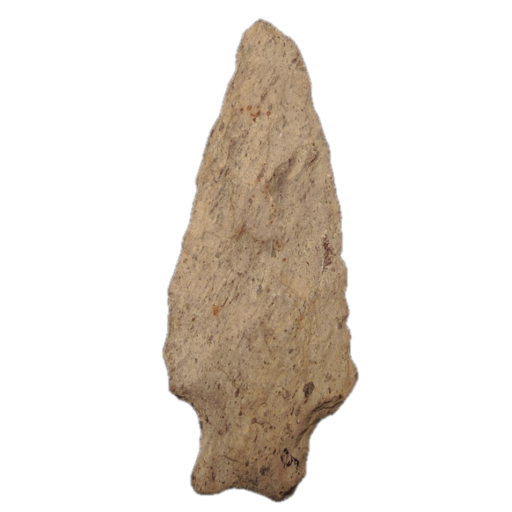
Arrowhead type
Bare Island Point
Bare Island4,500 - 3,000 B.P.Late Archaic hunter-gatherer groups of the Northeast and Middle Atlantic.3 reference photos
Key facts
- Age
- 4,500 - 3,000 B.P.
- Cultural period
- Late Archaic hunter-gatherer groups of the Northeast and Middle Atlantic.
- Size
- Small to Medium
- Shape
- Stemmed
- Glacial period
- Late Holocene
More from the Archaic period
Description
A Bare Island point is a medium-sized, stemmed, bifacially flaked projectile point with a broad blade, straight to slightly excurvate edges, and a short, often contracting stem. Shoulders are typically weak or indistinct. Bases are usually straight or slightly concave. These points were used for both spear and dart tips during the Late Archaic period. Many Bare Island specimens show multiple resharpening episodes, which reduce the blade width and alter the edge profile over time.
Size
Typical length ranges from 4 to 8 cm (1.5 to 3 inches). Width usually ranges from 2 to 4 cm (0.75 to 1.5 inches). Thickness ranges from 0.5 to 0.9 cm. Blade edges may be straight or slightly convex. The stem is short, usually narrower than the blade, and may contract slightly toward the base. Bases may show edge grinding from hafting. Cross-section is lenticular due to bifacial thinning. Many examples exhibit edge beveling from repeated sharpening.
Distribution
Bare Island points occur primarily in the Middle Atlantic and Northeastern United States. They are most common in Pennsylvania, New Jersey, New York, Delaware, Maryland, and parts of Virginia. Additional examples occur in southern New England. Distribution strongly overlaps with Late Archaic hunter-gatherer sites along river valleys, ridges, and estuarine zones. Bare Island points frequently appear at campsites, rock shelters, and tool-production areas.
Additional information
Bare Island points are important markers of Late Archaic occupation in the Middle Atlantic region. Their form suggests use as multi-purpose cutting and hunting tools. The short stem and ground hafting areas indicate secure mounting in foreshafts or handles. Many examples are produced from local cherts, jasper, quartzite, and argillite. Bare Island is sometimes confused with Poplar Island and Lehigh types, but its short stem and broader blade distinguish it. These points often appear alongside tools for fishing, wood processing, and plant collection.