
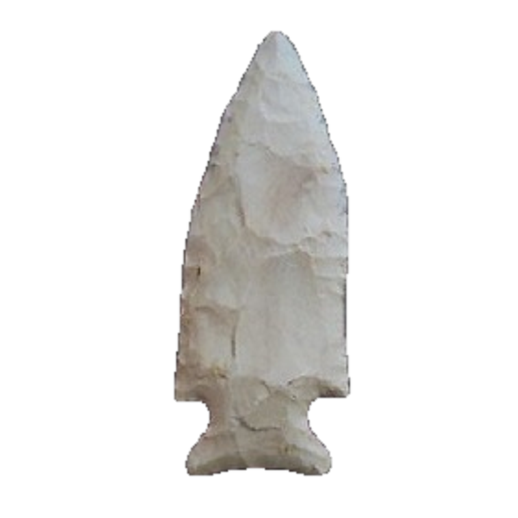
Arrowhead type
Jacks Reek Corner Notch Point
Jacks Reek Corner NotchJacks Reef Cluster1,500 - 1,000 B.P.Woodland14 reference photos
Key facts
- Age
- 1,500 - 1,000 B.P.
- Cultural period
- Woodland
- Culture
- Point Peninsula Culture
- Size
- Small to Medium
- Shape
- Corner Notch to Expanding Stem
- Glacial period
- Roman to Medieval Warm
More from the Woodland period
Description
This corner notch point exhibits a slender, broad profile, measuring between 1.25 and 2 inches in width, with a shape that varies from triangular to pentagonal. In cross-section, the point is predominantly flat, although occasional specimens display an elliptical profile. The blade's curvature ranges from excurvate to angular, with parallel sides that converge at the tip. The shoulders are characterized by thin, sharp barbs that can vary significantly in size. The stem expands outward, while the base is typically straight, although it may be slightly concave in some instances. The presence of basal thinning and grinding or smoothing is a common feature. The flaking pattern on this point is random, lacking a consistent or organized arrangement.
Size
The dimensions of the arrowheads are as follows: they typically range in overall length from 25 to 65 mm, with an average length of 42 mm. The stem measures between 6 and 12 mm in length, averaging 8 mm. The blade width varies from 15 to 30 mm, with an average width of 19 mm. The neck width ranges from 10 to 20 mm, while the stem width at its base measures between 13 and 23 mm, averaging 16 mm. In terms of thickness, the arrowheads are between 3 and 5 mm thick.
Distribution
This type is predominantly located in the Seneca River valley of upstate New York and extends into the Great Lakes territory and New England. It also appears with decreased regularity in eastern Illinois and northern Alabama
Mainly found in
Also found, less often, in
Additional information
The classification of certain arrowhead types has undergone significant refinement over the years. Initially, Ritchie coined the term "Broad Corner Notch" to describe these distinctive points, a designation that was later revised. As noted by Cambron in 1975, this reevaluation marked an important milestone in the understanding of these artifacts. Further research by Coe in 1995 shed additional light on the geographic distribution and chronological context of these points, suggesting that they first emerged in the northeastern region of North America before spreading eastward and westward from this core area.
The resultant diffusion of these points across the continent implies that specimens found outside the northeast would be relatively younger than their northeastern counterparts. A notable example of this phenomenon can be observed in the Ohio River Valley, where these points are closely associated with the Intrusive Mound Culture. In this specific context, the points are referred to as "Intrusive Mound Corner Notch," a designation that reflects their cultural affiliation and distinct morphological characteristics. This nuanced understanding highlights the complex dynamics of cultural exchange and technological diffusion that shaped the prehistoric landscape of North America.
The study of these arrowhead types offers valuable insights into the migratory patterns, trade networks, and cultural interactions of ancient Native American societies. By examining the distribution, morphology, and chronological context of these points, researchers can reconstruct a more detailed picture of the historical processes that shaped the lives of these communities. As archaeological investigations continue to uncover new evidence, our understanding of these enigmatic artifacts will undoubtedly evolve, providing a richer and more nuanced appreciation for the complexities of Native American cultural heritage.
Identified by
- Named by
- William A. Richie
- Year
- 1961
- Type site
- Jacks Reef Site, Onondaga County, New York
Similar types
Types that are easy to confuse with the Jacks Reek Corner Notch point.
Other types in the Jacks Reef Cluster
- Intrusive Mound
- Jacks Reef Pentagonal
- Knight Island
- Raccoon Creek