
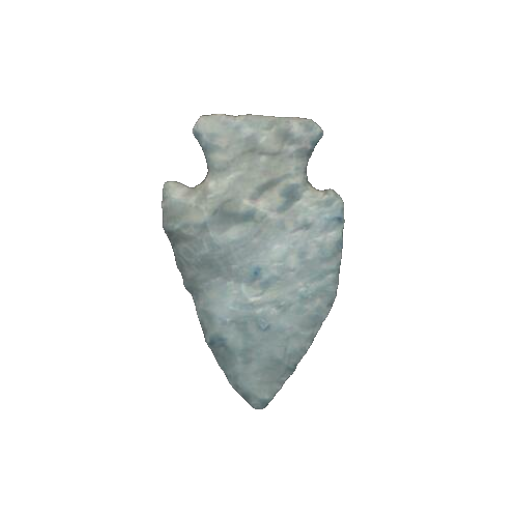
Arrowhead type
Intrusive Mound Point
Intrusive MoundJacks Reef Cluster1,500 - 1,000 B.P.Woodland18 reference photos
Key facts
- Age
- 1,500 - 1,000 B.P.
- Cultural period
- Woodland
- Culture
- Intrusive Mound Culture
- Size
- Medium
- Shape
- Corner Notch to Expanding Stem
- Glacial period
- Roman to Medieval Warm
More from the Woodland period
Description
This medium-sized corner notch point exhibits a distinctive shape, oscillating between triangular and pentagonal forms. In cross-section, the profile is predominantly flat, although occasional specimens display an elliptical configuration. The blade's morphology varies, spanning from excurvate to angular terminations, with the lateral edges often maintaining a parallel alignment. The stem expands outward, while the base typically presents a straight edge, sometimes subtly concave. Characteristic features include basal thinning and grinding, which are commonly observed. The flaking pattern on this point is random, lacking a discernible order or orientation.
Size
The dimensions of the arrowheads are as follows: they typically range in overall length from 30 to 55 mm, with an average length of 39 mm. The stem measures between 6 and 9 mm in length, averaging 7 mm. The blade width varies from 15 to 24 mm, with an average width of 18 mm. The neck width ranges from 9 to 19 mm. At its base, the stem width is between 13 and 24 mm, averaging 15 mm. In terms of thickness, the arrowheads measure between 3 and 5 mm.
Distribution
This projectile is mainly linked to the Intrusive Mound Culture of Ohio and the Ohio River valley. This projectile can also be discovered in western New York and Ontario
Additional information
In the realm of Native American arrowhead identification, a particular point is often misattributed to the Jacks Reef Corner Notch type. However, a closer examination reveals that this point is, in fact, a corner-notched projectile associated with the Intrusive Mound culture. Notably, the Intrusive Mound culture is also linked to another point type, known as Raccoon Creek, which differs from the present point in its side-notched configuration. This distinction highlights the importance of precise classification, as the corner-notched point in question exhibits a unique characteristic that sets it apart from its side-notched counterpart, Raccoon Creek, despite both being tied to the same cultural context.
The correct identification of this corner-notched point is crucial for understanding the technological and cultural developments of the Intrusive Mound people. By recognizing the distinctive features of this point, researchers can gain insights into the daily lives and hunting practices of this ancient culture. The presence of corner notching on this point suggests a specific functional design, potentially indicating a preference for certain types of hunting or weaponry. In contrast, the side-notched Raccoon Creek point may have served a different purpose or been used in a distinct cultural context, despite being associated with the same Intrusive Mound culture.
The study of these points, including the corner-notched point in question and the Raccoon Creek point, contributes to a broader understanding of the Intrusive Mound culture and its place within the larger narrative of Native American archaeological history. By carefully examining the characteristics of these points and their cultural associations, archaeologists can reconstruct a more nuanced picture of the lives and traditions of the people who created them, ultimately enriching our knowledge of the region's rich cultural heritage.
Identified by
- Named by
- Robert Converse
- Year
- 1963
Similar types
Types that are easy to confuse with the Intrusive Mound point.
Other types in the Jacks Reef Cluster
- Jacks Reef Corner Notch
- Knight Island
- Raccoon Creek