
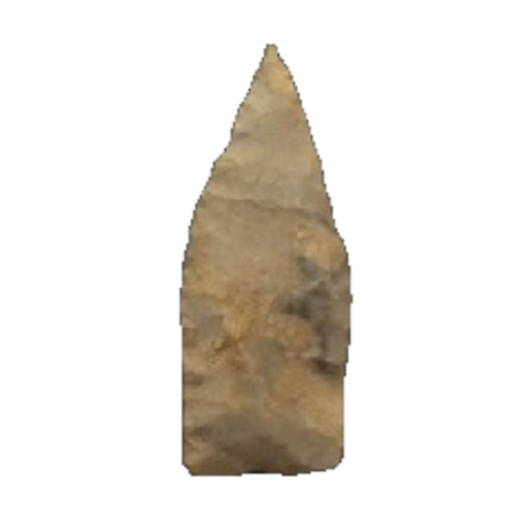
Arrowhead type
Jacks Reef Pentagonal Point
Jacks Reef PentagonalMississippian Pentagonal Cluster1,500 - 1,000 B.P.Woodland16 reference photos
Key facts
- Age
- 1,500 - 1,000 B.P.
- Cultural period
- Woodland
- Culture
- Point Peninsula Culture
- Size
- Small to Medium
- Shape
- Triangle to Lanceolate
- Glacial period
- Roman to Medieval Warm
More from the Woodland period
Description
This pentagonal point exhibits a slender profile, measuring between 0.5 and 0.75 inches in width, with a cross-sectional morphology that is distinctly flattened. The dorsal outline of the blade can range from a straight alignment to a gently curved, excurvate shape, extending from the apex to the proximal hafting area. The hafting region itself may display a range of configurations, from a straight to a more constricted form, which contributes to the point's characteristic pentagonal silhouette. The overall symmetry of the blade can vary, presenting as either symmetrical or asymmetrical. The basal edge is typically straight, although occasional specimens exhibit a concave base. The flaking pattern observed on this point is random, lacking a discernible, organized arrangement.
Size
The arrowheads exhibit a range of dimensions, with total lengths spanning 25 to 61 mm, and an average length of 42 mm. The hafting area, specifically, measures between 12 and 28 mm in length, with a mean of 20 mm. In terms of width, the arrowheads vary from 21 to 24 mm, averaging 23 mm. Additionally, the thickness of these artifacts ranges from 3 to 8 mm.
Distribution
This type is mainly located in the Northeast and extends into the Ohio River valley and Great Lakes area. It can also be discovered in other noted regions, albeit less often. Yellow denotes the range of the Pee Dee point, while green signifies the territory of the South Appalachian Pentagonal
Mainly found in
Also found, less often, in
Additional information
In the realm of Native American archaeology, the Jack's Reef Pentagonal and Pee Dee arrowheads are considered to be interchangeable terms, referring to the same distinct point type. Notably, the nomenclature varies by region, with the term "Jack's Reef Pentagonal" being commonly used in the Northeast, as well as the Ohio and Tennessee river basins. In contrast, the same point type is referred to as "Pee Dee" in Virginia and the Carolinas. Interestingly, this point has also been identified as the "Mississippi Pentagonal point" by Cambron in 1975, highlighting its widespread geographic distribution.
From a morphological perspective, the Jack's Reef Pentagonal point bears a resemblance to the Jack's Reef Corner Notch, albeit with a key distinction: the absence of a hafting element. This has led some researchers to propose that the Jack's Reef Pentagonal point may have served as a preform for the Jack's Reef Corner Notch. However, as Justice noted in 1987, these points were not only used as intermediates in the manufacturing process but also functioned as finished tools in their own right. The origins of the Jack's Reef Pentagonal point are thought to be linked to the Atlantic Coast, with Lowe's 2013 research suggesting that they subsequently spread westward, highlighting the complex dynamics of cultural exchange and technological diffusion in prehistoric Native American societies.
The study of the Jack's Reef Pentagonal point offers valuable insights into the technological and cultural practices of Native American groups, underscoring the importance of considering regional variations in nomenclature and the complexities of point typology. By examining the distribution, morphology, and functional significance of this point type, researchers can gain a deeper understanding of the social, economic, and environmental contexts in which they were produced and used. As such, continued research into the Jack's Reef Pentagonal point and its counterparts can provide a more nuanced appreciation of the rich cultural heritage and technological sophistication of Native American communities.
Identified by
- Named by
- William A. Richie
- Year
- 1961
- Type site
- Jacks Reef Site, Onondaga County, New York
Similar types
Types that are easy to confuse with the Jacks Reef Pentagonal point.
- Caraway
- Levanna
- Madison
- Mouse Creek
- Pee Dee
- South Appalachian Pentagonal
- Susquehannock Triangle
Other types in the Mississippian Pentagonal Cluster
- Intrusive Mound
- Knight Island
- Raccoon Creek