
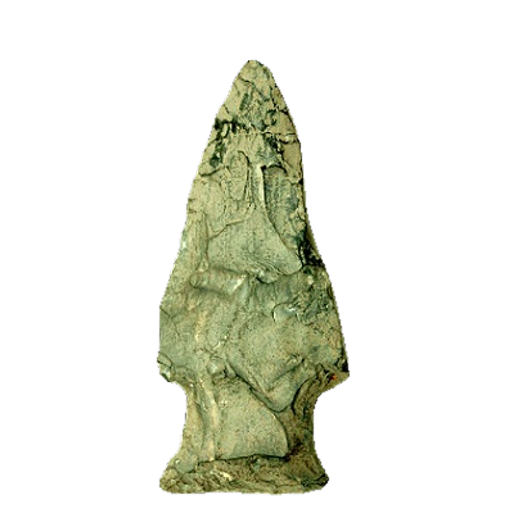
Arrowhead type
Vosberg Point
VosbergBrewerton Corner Notch Cluster5,200 - 4,500 B.P.Middle Archaic7 reference photos
Key facts
- Age
- 5,200 - 4,500 B.P.
- Cultural period
- Middle Archaic
- Size
- Small to Medium
- Shape
- Corner Notch to Side Notch
- Glacial period
- Middle Holocene
More from the Archaic period
Description
This triangular point exhibits a distinctive morphology, characterized by a small to medium size and an elliptical cross-sectional profile. The blade edge can vary in curvature, ranging from a pronounced excurvate shape to a straight alignment. A notable diagnostic feature of this point is the presence of small, narrow notches situated at the corners of the triangular preform, typically positioned near the base. The shoulders are generally oriented horizontally, although some specimens may display a slight barbing. The stem is short and expands outward, terminating in a base that can be either straight or concave. Many examples of this point type exhibit basal grinding, indicating deliberate edge modification. The flaking pattern observed on this point is random, lacking a consistent or organized arrangement of flake scars.
Size
The dimensions of the arrowheads are characterized by the following measurements: overall length ranges from 25 to 70 mm, with a mean length of 37 to 51 mm. The stem measures between 6 to 10 mm in length. In terms of width, the blade spans 16 to 27 mm, while the neck and stem widths are 13 to 22 mm and 18 to 24 mm, respectively.
Distribution
This type is mainly discovered from Pennsylvania and extending into eastern Ohio, Eastern New York, and throughout New England. This type may also occur with decreased regularity in other specified regions.
Additional information
In his seminal work published in 1961, William Ritchie observed that a particular type of arrowhead exhibits a range of morphological characteristics that overlap with those of the Brewerton Corner Notch type. This notable observation highlights the complexity and diversity of prehistoric projectile point typologies. The Brewerton Corner Notch type, a distinct category of arrowhead, is characterized by its unique combination of traits, including a corner-notch base and a specific blade shape. The fact that certain points exhibit morphological similarities to this type underscores the challenges of categorizing and distinguishing between different arrowhead styles, which often blended or evolved over time.
Ritchie's findings emphasize the importance of careful analysis and consideration of multiple characteristics when attempting to classify and date archaeological artifacts, such as arrowheads. By examining the morphological range of a particular point, researchers can gain insights into the technological, cultural, and historical contexts in which they were created and used. In this case, the connection to the Brewerton Corner Notch type suggests a potential cultural or temporal affiliation, which can inform our understanding of the lives and traditions of the Native American communities that crafted and utilized these artifacts.
The study of arrowhead typologies, including the Brewerton Corner Notch type, continues to be an active area of research in archaeology, with ongoing efforts to refine our understanding of the chronology, distribution, and cultural significance of these artifacts. As new discoveries are made and existing collections are re-examined, our knowledge of the complex and dynamic histories of Native American communities will continue to grow, shedding light on the intricate relationships between technology, culture, and environment that shaped the lives of these ancient societies.
Identified by
- Named by
- William A. Richie
- Year
- 1961
- Type site
- Robinson Site, Onondaga County, New York
Similar types
Types that are easy to confuse with the Vosberg point.
- Crooked Creek
- Godar
- Jacks Reef Corner Notch
Other types in the Brewerton Corner Notch Cluster
- Brewerton Corner Notch
- Brewerton Side Notch
- Lycoming County