
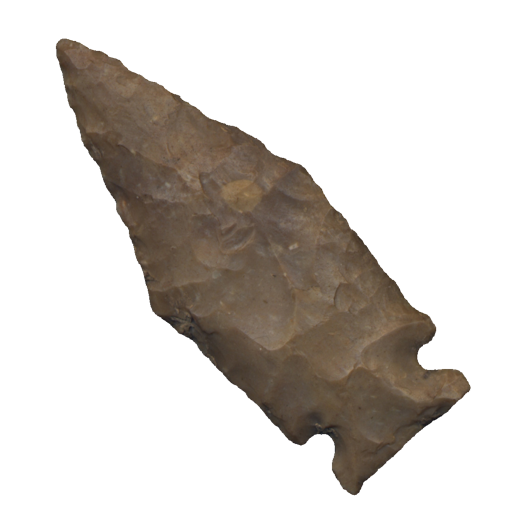
Arrowhead type
Knight Island Point
Knight IslandJacks Reef Cluster1,500 - 1,000 B.P.Late Woodland to Early Mississippian13 reference photos
Key facts
- Age
- 1,500 - 1,000 B.P.
- Cultural period
- Late Woodland to Early Mississippian
- Size
- Medium
- Shape
- Side Notch
- Glacial period
- Roman to Medieval Warm
More from the Woodland, Mississippian periods
Description
This medium-sized side-notched point exhibits a distinctive triangular to pentagonal silhouette. Its cross-sectional profile is predominantly flat, although occasional specimens may display an elliptical shape. The blade's morphology varies from excurvate to angular, with the lateral edges typically running parallel to each other. Characteristic narrow, parallel notches define the horizontal shoulders, while the stem is noticeably expanded. The base of the point is usually straight, often accompanied by basal thinning and evidence of grinding. The flaking pattern on this point is random, lacking a consistent or organized arrangement.
Size
The dimensions of the arrowheads are as follows: they typically range in overall length from 40 to 60 mm, with an average length of 49 mm. The stem section measures between 5 and 11 mm in length, averaging 9 mm. The blade itself is 15 to 20 mm in width, with an average of 18 mm. The neck of the arrowhead is between 10 and 15 mm wide, while the stem is 14 to 20 mm in width, averaging 17 mm. In terms of thickness, the arrowheads measure between 3 and 6 mm.
Distribution
This type is mainly discovered in middle to western Tennessee and extending into northern Alabama, northern Mississippi, northeastern Missouri, and south-central to western Kentucky.
Mainly found in
Additional information
In the realm of Native American arrowheads, a particular point of interest has been noted for its distinctive characteristics. This point bears a resemblance to the Raccoon Creek point, with which it shares many similarities, although the two are not entirely identical. A key distinction lies in their cultural associations and geographic distributions: the Raccoon Creek point is typically linked to the Intrusive Mound culture, found in more northern regions, whereas this point is commonly discovered in southern areas, specifically within the W2 zone.
A comparative analysis with other point types reveals that this arrowhead also shows affinity with the Jacks Reef Corner Notch, although a notable difference exists. Unlike the Jacks Reef Corner Notch, this point features a side notch, a distinctive trait that sets it apart from its corner-notched counterpart. This subtle yet significant variation highlights the diversity and complexity of Native American arrowhead designs, underscoring the importance of meticulous examination and classification in archaeological research.
The study of this point and its relationships with other types, such as the Raccoon Creek and Jacks Reef Corner Notch, contributes to a deeper understanding of the cultural and technological developments of Native American communities. By examining the distribution, design, and cultural associations of these arrowheads, researchers can gain valuable insights into the lives and traditions of these ancient societies, ultimately enriching our appreciation for the rich and varied heritage of Native American cultures.
Identified by
- Named by
- David Hulse
- Year
- 1964
- Type site
- Knight Island, Wheeler Reservoir, Tennessee River
Similar types
Types that are easy to confuse with the Knight Island point.
Other types in the Jacks Reef Cluster
- Jacks Reef Corner Notch
- Intrusive Mound
- Raccoon Creek