
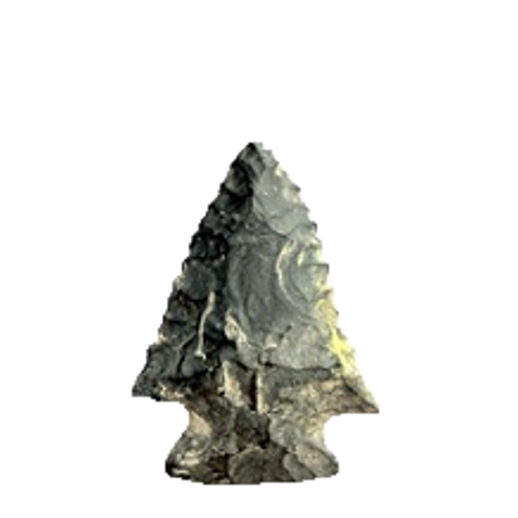
Arrowhead type
Palmer Point
PalmerKirk Corner Notch Cluster9,500 - 8,500 B.P.Early Archaic27 reference photos
Key facts
- Age
- 9,500 - 8,500 B.P.
- Cultural period
- Early Archaic
- Size
- Small
- Shape
- Corner Notch to Side Notch
- Material
- Quartz
- Glacial period
- Early Holocene
More from the Archaic period
Description
This diminutive triangular corner notch point, measuring under 2 inches in length, exhibits an elliptical profile. Its blade morphology is predominantly straight, although subtle variations may occur, ranging from a slight incurvature to a gentle excurvature. Serrations are a frequent feature on the blade edges of this point type. The shoulders are typically characterized by barbed morphology, but can also be oriented horizontally or display a slight upward slope. The stem expands in width, while the base is most often straight, with occasional deviations towards a convex or concave shape. Notably, the basal area often displays pronounced grinding and thinning, resulting in a smooth texture that facilitates hafting. The flaking pattern on this point is randomized, lacking a consistent or deliberate arrangement.
Size
The dimensions of the arrowheads are characterized by the following measurements: overall length ranges from 23 to 60 mm, with a typical average length of 26 to 35 mm. The stem portion measures between 4 and 12 mm in length, averaging between 7 and 9 mm. The blade itself spans a width of 14 to 29 mm, commonly falling within the 19 to 22 mm range. The neck width varies from 12 to 18 mm, with an average width of 14 to 16 mm. The basal width is between 15 and 25 mm, typically averaging 17 to 21 mm. Lastly, the thickness of the arrowheads ranges from 3 to 10 mm, with an average thickness of 8 mm.
Distribution
This type is mainly linked to the Atlantic Coast area of the United States, extending into the Gulf Coast area and the Tennessee River and Ohio River valleys. This type is discovered in the Mississippi River Valley and the Northeastern United States with lower regularity
Additional information
In the aftermath of the Hardaway occupation, a notable shift occurred in the design of projectile points, marked by the emergence of a small, corner-notched, serrated variety. A distinctive feature of these points is the extensive grinding evident along their bases. This stylistic change was accompanied by a significant increase in the use of small, hafted, snub-nosed scrapers. The evolution of this point style is believed to have given rise to the Kirk point, as noted by Coe in 1964, and later, the Decatur point, designated as W2. Interestingly, John Whatley has proposed a reclassification of the Bolen Corner Notch points, suggesting that the smaller specimens would be more accurately categorized as part of this initial style, while the larger examples would be better suited to the Kirk Corner Notch classification, as discussed by Schroder in 2013. This reevaluation highlights the complexities and nuances of projectile point typology, underscoring the need for ongoing refinement and precision in our understanding of these ancient artifacts.
Identified by
- Named by
- Joffre L. Coe
- Year
- 1964
- Type site
- Hardaway Site, Stanly County, North Carolina
Similar types
Types that are easy to confuse with the Palmer point.
- Autauga
- Brewerton
- Cypress Creek
- Ecusta
- Halifax
- Garver's Ferry
- Nettling
Other types in the Kirk Corner Notch Cluster
- Amos
- Charleston Corner Notch
- Decatur
- Kirk Corner Notch
- Pine Tree Corner Notch
- Stilwell