
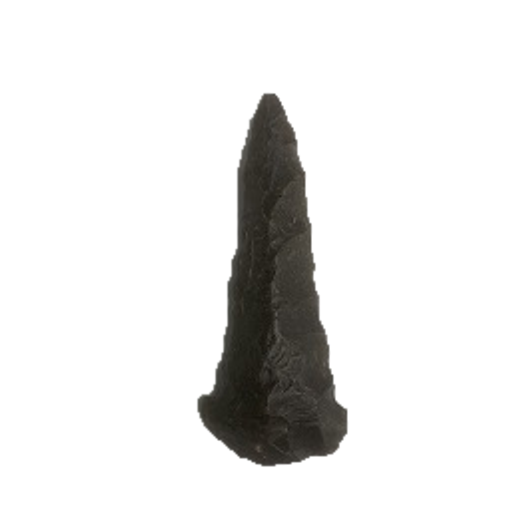
Arrowhead type
Fort Ancient Triangle Point
Fort Ancient TriangleLate Woodland Triangle Cluster to Early Mississippian Triangle Cluster800 - 400 B.P.Mississippian17 reference photos
Key facts
- Age
- 800 - 400 B.P.
- Cultural period
- Mississippian
- Culture
- Fort Ancient Culture
- Size
- Small to Medium
- Shape
- Triangle
- Glacial period
- Medieval Warm to Little Ice Age
More from the Mississippian period
Description
This triangular point measures between 1.25 and 2 inches in length, exhibiting a distinctive serrated edge. Its cross-sectional profile is elliptical, with a notable thickness throughout. The blade itself is predominantly straight, although occasional specimens may display a subtle incurvate curvature, and more rarely, a slight excurvate bend. Characterized by its elongated and slender shape, the blade often features pronounced serrations, while some examples lack serrations altogether. The base of the point can vary in shape, ranging from a straight edge to a convex curve, and may be thinned through basal reduction. Overall, this point showcases a high level of craftsmanship, as evidenced by its refined morphology and random flaking pattern, which suggests a meticulous and skilled manufacturing process.
Size
The dimensions of the arrowheads are characterized by a total length ranging from 30 to 50 mm, a maximum width of 15 mm or less, and a thickness spanning 4 to 7 mm, as initially documented by Bell in 1960.
Distribution
This type is predominantly found and typically linked to the Ohio River Basin and the Tennessee River Basin, including the upper reaches of both waterways.
Mainly found in
Also found, less often, in
Additional information
The discovery of trade goods from colonists at archaeological sites featuring these distinctive points indicates a notable overlap between the culture associated with these artifacts and the period of European settlement. As observed by Bell in 1960, the presence of such trade goods suggests that the use of these points may have persisted into the era of colonization. This finding provides valuable insight into the dynamics of cultural exchange and the adaptability of indigenous technologies during a time of significant societal change.
A characteristic feature of the Fort Ancient point, which distinguishes it from other related triangular points, is the presence of deep serrations. These serrations are a key diagnostic trait that aids in the identification of Fort Ancient points. Interestingly, the Sand Mountain point shares this characteristic, also exhibiting deep serrations. This similarity highlights the complexity of point typology and the need for careful consideration of multiple attributes when classifying and interpreting these artifacts. The deep serrations on both Fort Ancient and Sand Mountain points underscore the importance of detailed morphological analysis in understanding the technological and cultural contexts of these ancient tools.
The study of these points, including their distribution, morphology, and association with other artifacts, offers a unique window into the lives and traditions of the cultures that created them. By examining the characteristics of these points, such as the deep serrations, and their presence at sites with trade goods from colonists, researchers can gain a deeper understanding of the historical dynamics that shaped the lives of indigenous peoples during the period of European settlement. This knowledge not only enhances our appreciation of the past but also informs our perspective on the complex and often nuanced interactions between different cultures.
Identified by
- Year
- 1958
- Type site
- Most commonly associated with the Feurt Mounds and Village Scioto County, Ohio
Similar types
Types that are easy to confuse with the Fort Ancient Triangle point.
- Camp Creek
- Sand Mountain
- Tortugas