
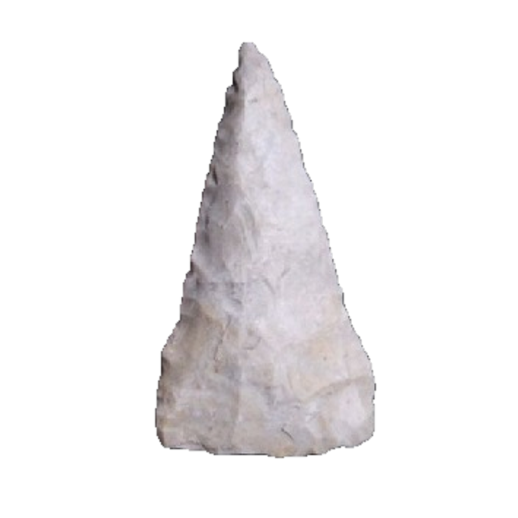
Arrowhead type
Fort Ancient Blade
Fort Ancient Blade800 - 400 B.P.Mississippian26 reference photos
Key facts
- Age
- 800 - 400 B.P.
- Cultural period
- Mississippian
- Culture
- Fort Ancient Culture
- Size
- Medium to Large
- Shape
- Triangle
- Glacial period
- Medieval Warm to Little Ice Age
More from the Mississippian period
Description
This point exhibits a medium to large size profile, characterized by an elliptical shape in cross-section. Its blade edge is predominantly linear, although it can display a subtle outward curvature, giving it an excurvate appearance. The basal morphology is variable, ranging from a straight to a convex outline, and often features basal thinning, which reduces the point's thickness at its base.
Size
The dimensions of the arrowheads are characterized by a total length ranging from 50 to 160 mm, with a mean length typically falling between 65 and 85 mm. The width of the blade spans from 25 to 40 mm.
Distribution
This type is predominantly found and typically linked to the Ohio River Valley and the Tennessee River Valley and the sources of both waterways.
Mainly found in
Also found, less often, in
Additional information
The discovery of trade goods from colonial-era interactions at archaeological sites featuring these distinctive points suggests a prolonged use of such artifacts, potentially extending into the period of European settlement. This notion is supported by research conducted by Bell in 1960, which implies a degree of cultural continuity despite the onset of colonial influences. Notably, these points are often found in conjunction with a specific type of blade or knife, a characteristic association that has been observed in the context of Fort Ancient points. This particular cultural affiliation is significant, as it provides valuable insights into the technological and social exchanges that occurred between indigenous populations and early colonists.
The presence of these points at sites with colonial-era trade goods underscores the complex dynamics of cultural interaction and exchange during this period. It highlights the adaptability and resilience of Native American communities, which continued to utilize traditional tools and technologies alongside introduced European goods. The specific blade or knife associated with Fort Ancient points is a noteworthy find, as it offers a glimpse into the daily lives and material culture of these communities. By examining the characteristics and distribution of these artifacts, researchers can reconstruct a more nuanced understanding of the social, economic, and technological networks that existed during this pivotal moment in American history.
The association between these points and Fort Ancient culture is particularly significant, as it sheds light on the technological and cultural practices of this indigenous group. Fort Ancient points are a distinctive type of projectile point, characterized by their unique morphology and craftsmanship. The fact that they are often found alongside a specific type of blade or knife suggests a high degree of standardization and consistency in the material culture of this group. As researchers continue to study these artifacts and their contexts, they may uncover further insights into the lives and traditions of the people who created and used them, ultimately enriching our understanding of Native American history and culture.
Similar types
Types that are easy to confuse with the Fort Ancient Blade point.
Other types in this cluster
- Fort Ancient