
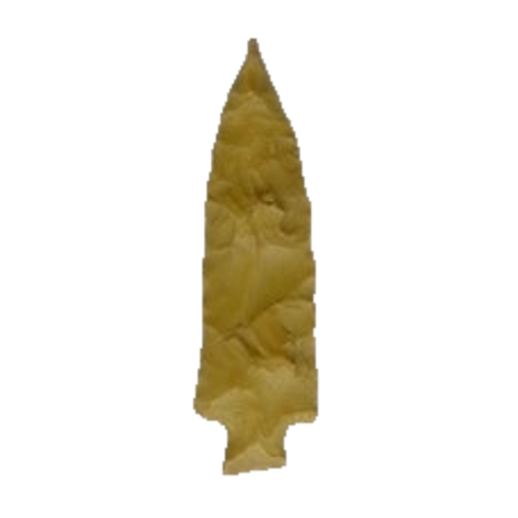
Arrowhead type
Collins Point
Collins1,500 - 1,200 B.P.Woodland12 reference photos
Key facts
- Age
- 1,500 - 1,200 B.P.
- Cultural period
- Woodland
- Size
- Small to Medium
- Shape
- Expanding Stem to Side Notch
- Material
- Quartzite
- Glacial period
- Vandal Minimum
More from the Woodland period
Description
This distinctive projectile point exhibits a triangular form with a side notch, giving rise to an expanding stem. Its cross-sectional profile is elliptical, providing a sturdy foundation for the blade. The blade's edge can range from straight to subtly curved, often becoming parallel as it approaches the shoulders. The apex of the point typically tapers inward, forming a sharp, needle-like tip. Although uncommon, some specimens display serrations along the blade's edge. The notches are broad and enter the blade at a low point, creating a shoulder that slopes upward and merges with the expanding stem. The stem's width can vary, sometimes extending to match the breadth of the shoulders. The basal edge of the point can be either slightly convex or concave, adding to the point's overall variability. The flaking pattern on this point is characterized by a random, non-patterned arrangement of flakes.
Size
The dimensions of the arrowheads are as follows: in terms of length, they range from 27 to 55 mm, with a mean length of 43 mm. The width spans from 10 to 14 mm, averaging 12 mm. Meanwhile, the thickness varies between 3 and 6 mm, with an average thickness of 4 mm.
Distribution
This type is mainly located in the western part of Mississippi and extends into southern Arkansas and northern Louisiana
Mainly found in
Additional information
More information needed.
Identified by
- Named by
- Jeffery B. Brain
- Year
- 1983
- Type site
- Lake George Site, Yazoo County, Mississippi
Similar types
Types that are easy to confuse with the Collins point.