
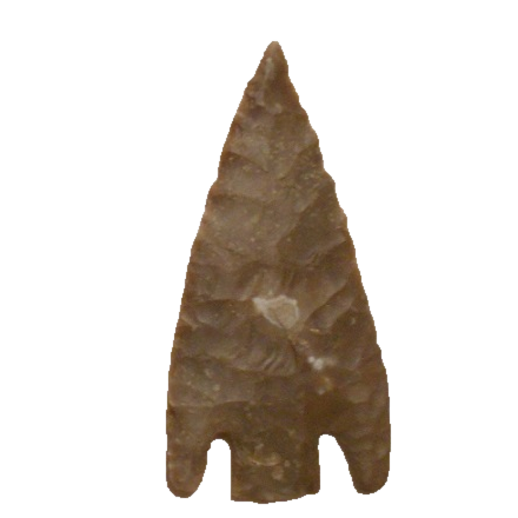
Arrowhead type
Marshall Point
Marshall4,000 - 2,000 B.P.Middle Archaic to Late Archaic21 reference photos
Key facts
- Age
- 4,000 - 2,000 B.P.
- Cultural period
- Middle Archaic to Late Archaic
- Size
- Medium to Large
- Shape
- Basal Notch to Corner Notch
- Material
- Pottery
- Glacial period
- Middle Holocene to Roman Warm
More from the Archaic period
Description
This basal notch point exhibits a distinctive morphology, characterized by a triangular to broadly oval shape, typically measuring between 2.5 to 3 inches in length. The cross-section is flattened, providing a stable platform for the blade, which can range from triangular to ovoid in shape. The blade's profile may be excurvate, straight, or, in re-sharpened specimens, slightly recurvate. The shoulders are notable for their pronounced barbing, often extending to the base of the point, with one barb frequently longer or more angular than the other. In some cases, the barbs may be smaller, imparting a corner-notched appearance rather than the typical basal notch morphology. The stem is generally straight, although it may exhibit a slight expansion, while the base can vary from concave to slightly concave. The overall craftsmanship of this point is exceptional, with a random flaking pattern that attests to the skill of its manufacturer.
Size
The dimensions of the arrowheads are characterized by a length range of 50 to 115 mm. The stem, which constitutes a portion of the overall length, typically spans between 12 to 25 mm, generally equivalent to 1/8 to 1/4 of the total length. In terms of width, the measurement across the barbs falls within the range of 30 to 50 mm, while the stem width is between 12 to 25 mm, as outlined by Suhm and Krieger (1954).
Distribution
This type is predominantly linked to the central region of Texas, yet can also occur in the north-eastern part of Texas, western Louisiana, southwestern Arkansas, and southern Oklahoma
Additional information
In the realm of Native American arrowhead typology, the Marshall point exhibits a notable similarity to other point styles, including the Castroville, Marcos, and Williams points. A key distinguishing feature of the Marcos point is the presence of a notch that originates from the base at a more pronounced angle compared to the Castroville and Marshall points. The Marshall point, on the other hand, is characterized by its narrower overall shape and a distinctly more slender stem than the Castroville point. Furthermore, the Williams point is recognizable by its barbs, which do not extend all the way to the base, a trait that may also be observed in re-sharpened Marshall points, which can sometimes take on the characteristics of a Williams point.
The Marshall point also shares certain characteristics with the Lange point, highlighting the complexity and overlap that can exist between different point styles. In terms of archaeological context, Marshall points are often found in association with Pedernales points, which can provide valuable insights into the cultural and temporal relationships between these point styles. However, it is worth noting that worn or damaged Marshall points can be challenging to distinguish from similarly worn Castroville points, as observed by Bell in 1958. This highlights the importance of careful analysis and consideration of multiple factors when attempting to identify and classify arrowhead points.
The Marshall point has been referred to by several different names throughout the history of its study, including the Marshall Barbed point, as well as the Smithwick Small Stem and Bluffton Barbed points, as documented by Bell in 1958. These varying designations reflect the ongoing refinement of our understanding of Native American arrowhead typology and the importance of continued research and scholarship in this field. By examining the characteristics and associations of the Marshall point, archaeologists can gain a deeper understanding of the cultural and technological practices of the Native American groups who created and utilized these points.
Identified by
- Year
- 1954
Similar types
Types that are easy to confuse with the Marshall point.