
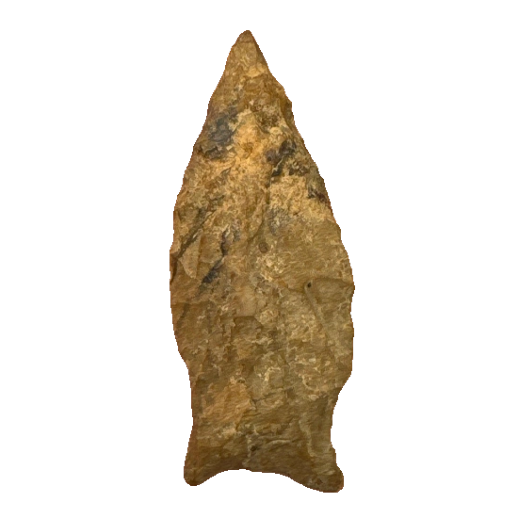
Arrowhead type
Orient Point
OrientSusquehanna Cluster3,200 - 2,600 B.P.Late Archaic to Early Woodland23 reference photos
Key facts
- Age
- 3,200 - 2,600 B.P.
- Cultural period
- Late Archaic to Early Woodland
- Culture
- Orient Culture from Long Island, New York
- Size
- Small to Medium
- Shape
- Expanding Stem to Auriculate
- Material
- Quartz
- Glacial period
- Neoglacial
Description
This lanceolate point typically measures between 2 to 2.5 inches in length, characterized by a slender blade that is predominantly excurvate, although asymmetry may occur in re-sharpened specimens. The cross-sectional profile ranges from flattened to elliptical, while the shoulders are rounded and incline upward. The stem is usually expanding, but occasional examples exhibit straight stems. The base is generally concave, sometimes approaching a straight configuration, and often displays a distinctive "fishtail" morphology, although an articulated appearance can occur in certain instances. Notably, basal grinding is a common feature of this point type. The flaking pattern on this point is random, lacking a discernible order or organization.
Size
The arrowheads exhibit a range of dimensions, with lengths spanning 38 to 102 mm, and an average length of 60 mm. The stem, measured from the base to the shoulder or blade junction, ranges from 13 to 19 mm in length. The blade itself is 14 to 25 mm in width, while the neck and basal widths are 11 to 18 mm and 13 to 20 mm, respectively. In terms of thickness, the arrowheads measure between 5 and 11 mm.
Distribution
This type is mainly discovered in the central to southern regions of the Hudson River Valley, spanning New York, New Jersey, and Long Island. Its range stretches into the Quinnipiac River Basin of Connecticut, the Tug River Valley of West Virginia, the Niagara Peninsula of Ontario, and reaches into Virginia.
Additional information
In a comparative analysis of Native American arrowhead types, notable distinctions emerge between the Orient and Drybrook points. A key characteristic of the Orient type, designated as W10, is its slender profile, which is accompanied by rounded shoulders and a more pronounced slope. This morphology sets it apart from the Drybrook point, which exhibits more angular shoulders, resulting in a subtly different overall shape. The contrast between these two point types highlights the diversity of arrowhead designs crafted by Native American cultures, reflecting varying functional and stylistic priorities.
The Orient point's rounded shoulders and sloping shape likely influenced its aerodynamics and penetrative capabilities, making it suited for specific hunting or warfare applications. In contrast, the Drybrook point's more angular shoulders may have provided additional strength or durability, potentially adapting it for use in different environmental or cultural contexts. By examining these variations, archaeologists can gain insights into the technological, social, and cultural factors that shaped the development of arrowhead designs among Native American communities.
Through the study of these point types, researchers can reconstruct aspects of the lives and traditions of the people who created them, including their technological expertise, hunting practices, and artistic expression. The Orient and Drybrook points, with their distinct morphological features, contribute to a broader understanding of the rich and complex heritage of Native American cultures, underscoring the importance of continued archaeological research and analysis to uncover the stories and significance of these ancient artifacts.
Identified by
- Named by
- William A. Richie
- Year
- 1961
- Type site
- Orient 1 and Orient 2 sites, Orient point, Long Island, New York
Similar types
Types that are easy to confuse with the Orient point.
- Forest
- Frost Island
- Taconic
Other types in the Susquehanna Cluster
- Ashtabula
- Dismal Swamp
- Drybrook
- Perkiomen
- Susquehanna Broad Spear
- Wayland