
Arrowhead type
Apple Blossom Point
Apple BlossomTable Rock Cluster3,500 - 2,500 B.P.Late Archaic to Early Woodland10 reference photos
Key facts
- Age
- 3,500 - 2,500 B.P.
- Cultural period
- Late Archaic to Early Woodland
- Size
- Small to Medium
- Shape
- Expanding Stem
- Glacial period
- Neoglacial
Description
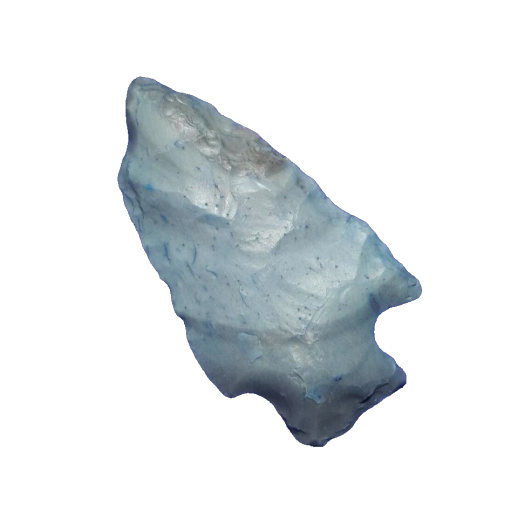
This triangular point exhibits a distinctive morphology, characterized by a stemmed design with an elliptical profile. The blade itself is marked by an excurvate shape, featuring broad, rounded notches that impart a sense of curvature. The shoulder morphology is typically horizontal, although variations can occur, ranging from a subtle barbed inclination to a slight upward tilt. The stem displays a range of expansion, from a slight to a more pronounced widening. The basal edge is generally straight, with a possible slight convexity, and is framed by rounded corners. In terms of flaking patterns, this point displays a random arrangement, often complemented by the presence of fine, meticulously applied pressure flaking.
Size
The dimensions of the arrowhead are as follows: it measures between 22 and 39 mm in overall length, with a stem length ranging from 4 to 7 mm. The blade itself spans 12 to 19 mm in width, while the neck measures between 7 and 11 mm across. Additionally, the stem width is recorded to be between 9 and 13 mm.
Distribution
This type is mainly discovered in the southern Ohio River basin and extending into the Illinois River basin. The University of Minnesota has documented this type being discovered as far as Minnesota. This type can also be discovered in the northern Mississippi River basin
Also found, less often, in
Additional information
In the realm of Native American arrowheads, the Apple Blossom point exhibits a notable similarity to the Bottleneck stemmed point, with a key distinction lying in its shorter stem. This variation has sparked debate among archaeologists, with Justice (2002) suggesting that points initially classified as Apple Blossom at the Koster site may have been misidentified as Bottleneck points. It is possible that these two types represent a single point style with differing stem lengths, rather than distinct categories. The transition from larger Archaic dart points to smaller Woodland arrow points may have driven this technological shift, resulting in the coexistence of both forms.
The Koster and Apple Blossom points share a common type site, which has led to dual nomenclature. The term "Koster" was coined by Perino in 1963, while Cook introduced the name "Apple Blossom" in 1976. Although both designations are recognized in professional literature, they differ in their associated chronology. Perino dated these points to between 2,500 and 1,500 years before present (B.P.), whereas Cook proposed a slightly earlier timeframe of 3,500 to 2,500 B.P. Despite these discrepancies, the characteristics of the Koster and Apple Blossom points remain largely consistent, with their shared attributes and type site solidifying their place in the archaeological record.
The dual naming of these points highlights the complexities of archaeological classification and the evolving nature of our understanding. Both the Koster and Apple Blossom designations appear in professional publications, reflecting the ongoing refinement of our knowledge. As researchers continue to examine and interpret the material record, the nuances of point typology and technological development will likely remain a focal point of investigation. By examining the subtle variations between point styles, such as the distinction between the Koster and Apple Blossom points, archaeologists can gain valuable insights into the lives and cultural practices of Native American communities, shedding light on the dynamic and often complex history of these regions.
Identified by
- Named by
- Thomas G. Cook
- Year
- 1976
- Type site
- Koster Site, Illinois
Similar types
Types that are easy to confuse with the Apple Blossom point.