
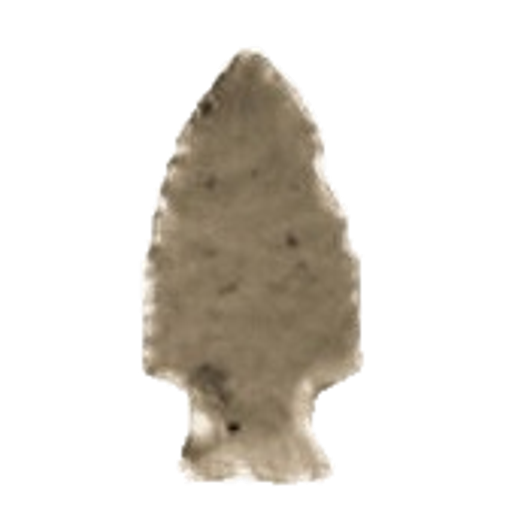
Arrowhead type
Koster Point
KosterLate Woodland Stemmed Cluster to Late Woodland Corner Notch Cluster2,500 - 1,500 B.P.Woodland7 reference photos
Key facts
- Age
- 2,500 - 1,500 B.P.
- Cultural period
- Woodland
- Size
- Small
- Shape
- Corner Notch to Side Notch to Expanding Stem
- Glacial period
- Roman Warm
More from the Woodland period
Description
This corner-notch point exhibits a slender profile with a compressed cross-sectional morphology. The blade's curvature can vary from pronounced excurvate shapes to straight configurations, often accompanied by delicate serrations. Characteristically, the shoulders are broad and bear barbed formations. The stem expands outward, terminating in a base that ranges from straight to convexly curved. Notably, basal grinding is not a feature of these points. The flaking pattern appears random, suggesting a moderate level of craftsmanship was employed in their manufacture.
Size
The dimensions of the arrowheads are as follows: they range in overall length from 22 to 39 mm, with the stem measuring between 4 and 7 mm. The blade itself spans 12 to 19 mm in width, while the neck measures 7 to 11 mm across. Additionally, the width of the stem is recorded as being between 9 and 13 mm.
Distribution
This type is mainly discovered in the northern Mississippi River region and extends into southeastern Iowa and southeastern Minnesota.
Also found, less often, in
Additional information
The evolution of certain Native American arrowhead types has been a subject of interest among archaeologists, with Perino (1971) proposing a sequential development from side-notch to corner-notch, and ultimately to spike-like points. Notably, the Koster and Apple Blossom points share a common type site, which was first identified by Perino in 1963. Perino's designation of these points as "Koster" was later complemented by Cook's terminology, "Apple Blossom," introduced in 1976. Although the two researchers differ in their chronology, with Perino dating these points between 2,500 and 1,500 years before present (B.P.) and Cook suggesting a slightly earlier timeframe of 3,500 to 2,500 B.P., their descriptions of the points' characteristics converge.
A closer examination of the Koster and Apple Blossom points reveals that, despite the differing nomenclature and chronological attributions, these arrowheads exhibit a high degree of similarity in their morphological features. The fact that both types have been recognized and documented in professional publications underscores their significance within the archaeological community. The type site associated with these points has provided valuable insights into the technological and cultural developments of the Native American groups that created them. By analyzing the characteristics and distribution of these arrowhead types, researchers can gain a deeper understanding of the cultural exchange networks, technological innovations, and adaptive strategies employed by these ancient societies.
The recognition of the Koster and Apple Blossom points in the archaeological literature highlights the importance of standardized terminology and rigorous dating methods in the field. Despite the minor discrepancies in their chronological attribution, the consensus among researchers regarding the characteristics and significance of these points demonstrates the progress made in understanding the complexities of Native American cultural and technological evolution. As archaeological research continues to uncover new evidence and refine existing knowledge, the study of these arrowhead types will remain an essential component of a broader understanding of the region's rich cultural heritage.
Identified by
- Named by
- Gregory Perino
- Year
- 1963
- Type site
- Koster Site, Greene County, Illinois
Similar types
Types that are easy to confuse with the Koster point.