
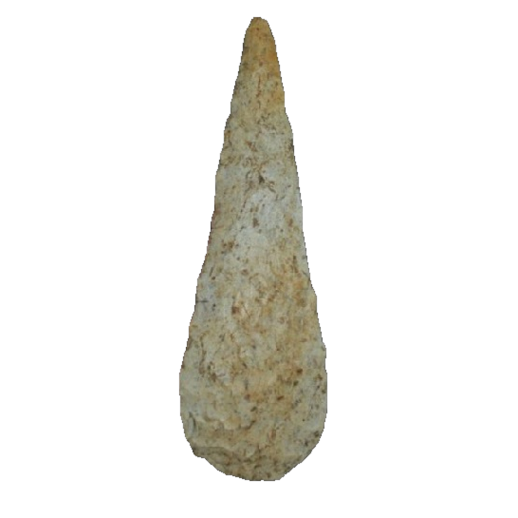
Arrowhead type
Cobbs Blade
Cobbs Blade8,500 - 5,000 B.P.Early Archaic to Middle Archaic20 reference photos
Key facts
- Age
- 8,500 - 5,000 B.P.
- Cultural period
- Early Archaic to Middle Archaic
- Size
- Medium to Large
- Shape
- Triangle to Ovoid
- Material
- Chert
- Glacial period
- Middle Holocene
More from the Archaic period
Description
This triangular blade exhibits a size range of 2.5 to 7 inches, characterized by a cross-sectional shape that transitions from flattened to rhomboid. The blade's profile can vary, ranging from excurvate to straight, and as it undergoes re-sharpening, it becomes increasingly narrower, with a broader hafting area that can develop into a recurvate form. Typically, one edge on each face features a steep bevel, although the hafting region remains unbeveled. The overall morphology of these points can be diverse, encompassing excurvate tips with parallel sides, triangular shapes, and even leaf- or ovoid-like appearances. The base of the blade can also vary, displaying a range of straight to convex configurations. The flaking pattern on these blades is random, with fine pressure flaking evident along the edges, often accompanied by a noticeable disparity in workmanship between the two faces, with one face typically exhibiting finer flaking than the other.
Size
The dimensions of the arrowheads are characterized by a total length ranging from 51 to 158 mm, with a mean length typically falling between 100 to 110 mm. The blade width spans from 32 to 51 mm, averaging between 40 to 45 mm.
Distribution
This type is mainly linked throughout the Ohio river basin, Tennessee River basin, and the Mississippi River basin. It is also discovered in the Virginia and Carolina foothills, and across the Gulf Coast area with less regularity.
Mainly found in
Also found, less often, in
Additional information
The function of these particular points has been a subject of debate among archaeologists. One theory is that they served as knives, given their characteristics. Alternatively, some researchers propose that these points were actually preforms, which would eventually be shaped into more refined early Archaic points, such as those classified as W11. Notably, Granger and Granger (2013) have suggested that this point type may have had a dual purpose, potentially representing both knives and preforms for other beveled point types, including the distinctive St. Charles point. This dual-function hypothesis highlights the complexity and versatility of these ancient tools, underscoring the resourcefulness and adaptability of the cultures that created them. By examining the characteristics and potential uses of these points, archaeologists can gain a deeper understanding of the technological and cultural developments of early Archaic societies.
Identified by
- Named by
- John Griffin
- Year
- 1974
- Type site
- Russell Cave, Alabama
Similar types
Types that are easy to confuse with the Cobbs Blade point.