
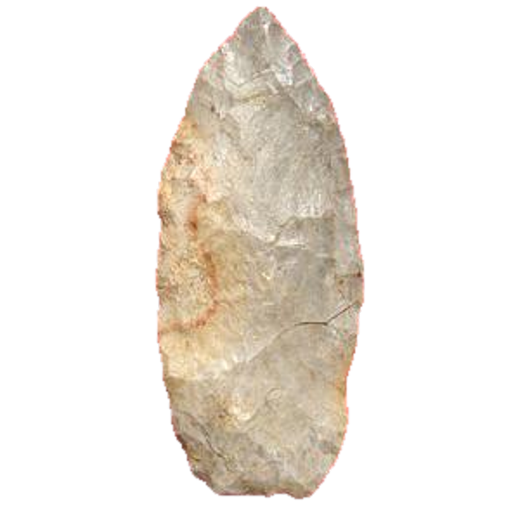
Arrowhead type
Benjamin Point
Benjamin3,000 - 1,600 B.P.Woodland2 reference photos
Key facts
- Age
- 3,000 - 1,600 B.P.
- Cultural period
- Woodland
- Size
- Medium to Large
- Shape
- Lanceolate
- Glacial period
- Neoglacial to Roman Warm
More from the Woodland period
Description
This lanceolate point exhibits a sizable, elongated form with a cross-sectional profile that is distinctly elliptical in shape. Its blade edge is characterized by a pronounced outward curvature, while the base can display a range of morphologies, including a concave shape or a straight edge, often accompanied by deliberate basal thinning to enhance its aerodynamic properties. The pattern of flake scars on the point's surface appears to be irregular and non-directional, indicative of a random flaking technique.
Size
The arrowheads exhibit a range of dimensions, with lengths spanning 54 to 100 mm, and an average length of 66 mm. In terms of width, they measure between 22 and 32 mm, with a mean width of 26 mm. The thickness of these artifacts falls within a range of 9 to 12 mm.
Distribution
This type mainly occurs in northern Alabama and extends into south central Tennessee, northeastern Mississippi, and northwestern Georgia
Mainly found in
Also found, less often, in
Additional information
More information needed.
Identified by
- Named by
- James Cambron and David Hulse
- Year
- 1962
- Type site
- Benjamin Site, Lawrence County, Alabama
Similar types
Types that are easy to confuse with the Benjamin point.
Other types in this cluster
- Copena
- Madison