
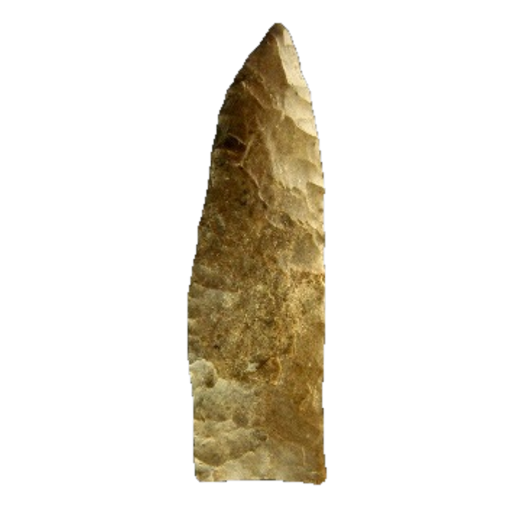
Arrowhead type
Frazier Point
Frazier3,500 - 1,800 B.P.Middle Paleo to Late Archaic12 reference photos
Key facts
- Age
- 3,500 - 1,800 B.P.
- Cultural period
- Middle Paleo to Late Archaic
- Size
- Medium
- Shape
- Lanceolate to Triangle to Ovoid
- Glacial period
- Neoglacial to Roman Warm
Description
This lanceolate point exhibits a slender profile, measuring between 2 and 2.75 inches in length, with a cross-sectional shape that is notably flattened. The blade's curvature is characterized by an excurvate shape, where the edges converge slightly towards the apex, while the majority of the blade displays nearly parallel margins. Fine serrations are often present along the blade's edge, a result of repeated re-sharpening. The basal morphology is typically marked by a subtle concavity, although some specimens may display a straight base. Notable basal thinning is evident, indicating deliberate reduction of the point's thickness at the base. The flaking pattern on this point is the result of a combination of primary percussion flaking and fine pressure flaking applied to all edges, yielding a random, multidirectional pattern of flake scars.
Size
The arrowheads exhibit the following dimensional characteristics: overall length ranges from 45 to 51 mm, with a mean length of 49 mm. The width varies between 21 and 25 mm, averaging 23 mm. In terms of thickness, the measurements fall within a range of 6 to 8 mm.
Distribution
This style is mainly located in the Tennessee River Valley of southeastern Kentucky and Tennessee. Cambron notes that this style is scarce in Alabama.
Also found, less often, in
Additional information
The chronology of this particular arrowhead point has been a subject of debate among archaeologists. While Kneberg (1956) suggests that it dates back to the period between 1,500 B.C. and 100 A.D., categorizing it as a Late Archaic to Early Woodland point, Cambron (1975) proposes an alternative timeline. Cambron argues that the point may actually be an Early Archaic type, with a date range of approximately 6,000 to 4,000 B.C., based on surface collections from Early Archaic sites and associations with other points from the same period.
Notably, the characteristics of this point seem to support Kneberg's assessment. Unlike many Early Archaic type points, which often exhibit hafting region grinding, this point rarely displays such features. Instead, it is distinguished by its narrower shape, flatter base, and high-quality flaking. In comparison to the similar Paint Rock Valley point, described by Cambron in 1969, this point exhibits a more refined morphology. The absence of hafting region grinding, in particular, suggests that this point may indeed be more closely affiliated with the Late Archaic to Early Woodland period, as proposed by Kneberg.
The distinct characteristics of this point, including its narrower profile and superior flaking quality, set it apart from other points of the same general type. As such, it provides valuable insights into the technological and stylistic developments of Native American arrowhead production during this period. Further study of this point and its counterparts can help to shed light on the cultural and historical contexts in which they were created, ultimately contributing to a more nuanced understanding of the lives and traditions of the indigenous peoples who crafted them.
Identified by
- Named by
- Madeline Kneberg
- Year
- 1956
- Type site
- Frazier Site, Benton County, Tennessee
Similar types
Types that are easy to confuse with the Frazier point.
- Copena
- Greenville
- Guntersville
- Stanfield
- Paint Rock Valley