
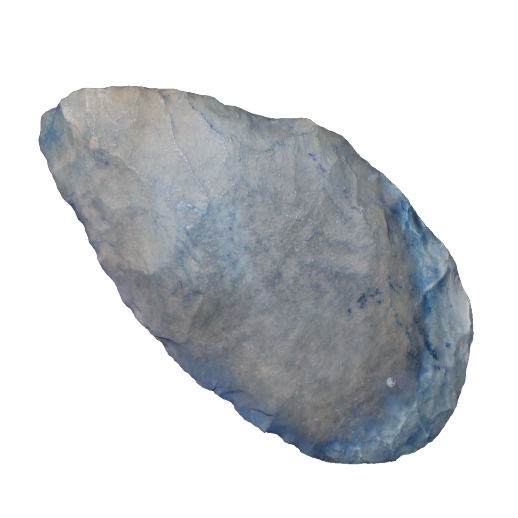
Arrowhead type
Abasolo Point
Abasolo7,000 - 5,000 B.P.Middle Archaic10 reference photos
Key facts
- Age
- 7,000 - 5,000 B.P.
- Cultural period
- Middle Archaic
- Size
- Medium to Large
- Shape
- Ovoid
- Material
- Steel
- Glacial period
- Middle Holocene
More from the Archaic period
Description
This ovoid blade, typically measuring between 1.5 to 2.5 inches in length, exhibits an elliptical cross-sectional profile. Its excurvate shape can manifest in various forms, ranging from a triangular expansion from the tip to the base, to a curved outline that broadens at the midpoint to the lower third of the blade, before tapering inward toward the base, resulting in a distinctive teardrop silhouette. The edges of the blade often display a beveled or steeply chipped pattern, which may be confined to alternating edges or extend to all edges. A notable characteristic of this type is the convex base, marked by rounded basal corners that form a semicircular shape. Basal thinning is also a common feature. The point was fashioned using percussion flaking, with a noticeable variation in flaking pressure: heavier pressure flaking is evident near the tip, while lighter pressure flaking is used along the base, yielding a random, non-patterned flaking arrangement.
Size
The dimensions of these arrowheads are characterized by a length range of 35 to 110 mm, with a mean length typically falling between 53 and 60 mm. In terms of width, the measurements span from 21 to 45 mm, averaging between 25 and 30 mm. The thickness varies from 6 to 14 mm, with an average thickness of 11 mm, as documented by Suhm and Krieger (1954) and MacNeish (1967).
Distribution
This arrowhead type is mainly discovered in the Rio Grande river system of Texas and extends into southern Tamaulipas and eastern Nuevo Leon, Mexico. It has also been identified in Mexico Valley, Tehuacan Valley, and Cueva de la Nopaler Hidalgo. The distribution of this point tapers off as it moves into the coastal areas and central Texas
Additional information
In the realm of Native American lithic artifacts, the Abasolo type is notable for its distinctive characteristics, which suggest it may have been utilized as a knife rather than a projectile point. A comparative analysis with other regional point types, such as the Tortugas and Catan, reveals intriguing similarities and differences. The Tortugas point, for instance, is distinguished by its straight base, whereas the Catan point is significantly smaller in size compared to the Abasolo (Turner and Hester, 1985).
The Abasolo type also bears resemblance to the Covington Knife, found in central Texas, although the two exhibit distinct morphological differences. The Covington Knife tends to be broader, with more angular basal corners, in contrast to the Abasolo's narrower profile and rounded basal corners. Another related type, the Refugio, is generally larger in size than the Abasolo. The Abasolo's semicircular base serves as a key diagnostic feature, distinguishing it from the Tortugas point, with which it shares a familial relationship.
Further comparisons with other point types, such as the Catan and Desmuke, provide additional insights into the Abasolo's unique characteristics. The Catan point, for example, exhibits a similar outline to the Abasolo but is significantly smaller in size. In contrast, the Desmuke point is distinguished by its pointed base, which differs from the Abasolo's convex base (Suhm and Krieger, 1954). These comparative analyses underscore the importance of careful examination and classification of lithic artifacts, highlighting the complexities and nuances of Native American technological and cultural expressions.
Identified by
- Named by
- Richard MacNeish
- Year
- 1950
- Type site
- Tamaulipas, Mexico
Similar types
Types that are easy to confuse with the Abasolo point.