
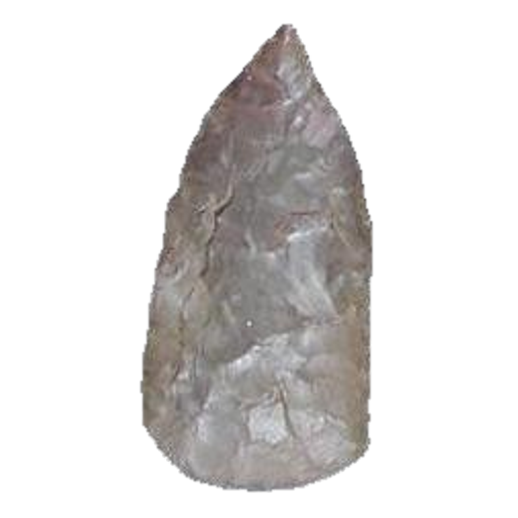
Arrowhead type
Copena Round Base Point
Copena Round BaseCopena Cluster4,000- 1,500 B.P.Late Archaic to Woodland3 reference photos
Key facts
- Age
- 4,000- 1,500 B.P.
- Cultural period
- Late Archaic to Woodland
- Culture
- Copper Burial Mound Culture
- Size
- Medium to Large
- Shape
- Ovoid
- Material
- Pottery
- Glacial period
- Neoglacial to Roman Warm
Description
This artifact exhibits a medium to large size, characterized by an elliptical profile. Its overall morphology varies between triangular and ovoid forms, reminiscent of a leaf shape. The blade itself is excurvate, often becoming more linear as it approaches the hafting region. The base of the point is marked by a convex curvature, which may be accompanied by evidence of basal grinding or thinning. The flaking pattern observed on this specimen is random, lacking a discernible or systematic arrangement.
Size
The dimensions of these arrowheads are characterized by a total length ranging from 45 to 130 mm, with a mean length of 75 mm. The width of the blade spans from 25 to 40 mm, while the thickness measures between 7 and 10 mm, as determined from a limited dataset.
Distribution
This type is mainly located in the Tennessee River Valley. It can also be discovered in the Ohio River Valley, the central Mississippi River valley and the southeastern Coastal Plain region
Mainly found in
Also found, less often, in
Additional information
The Copena culture is a distinct archaeological phenomenon predominantly linked to the northern region of Alabama. One of the hallmark characteristics of this culture is its notable use of copper and galena in burial artifacts. The presence of these specific materials in funerary contexts has led researchers to derive the culture's name, "Copena," directly from the combination of "copper" and "galena." This unique association underscores the significance of these materials in the cultural and ritual practices of the Copena people, providing valuable insights into their technological, social, and spiritual developments.
The incorporation of copper and galena into burial artifacts suggests a level of sophistication in the culture's metallurgical and ritual practices. Copper, a highly valued material for its durability and aesthetic appeal, was often used in the creation of various artifacts, including tools, ornaments, and ceremonial objects. Galena, a lead sulfide mineral, was also prized for its shiny, metallic appearance and potential use in pigments or ceremonial contexts. The deliberate inclusion of these materials in burials implies a complex funerary ritual, where the deceased were accompanied by goods believed to hold spiritual or practical significance in the afterlife.
The study of Copena culture offers a fascinating glimpse into the lives and traditions of Native American communities in northern Alabama. By examining the material culture, particularly the use of copper and galena in burial contexts, archaeologists can reconstruct aspects of Copena society, including their technological capabilities, trade networks, and spiritual beliefs. This culture's distinct characteristics serve as a testament to the diversity and richness of Native American heritage, highlighting the importance of continued research and preservation of these invaluable archaeological resources.
Identified by
- Named by
- William Webb and David DeJannette
- Year
- 1942
- Type site
- Pickwick Basin, northern Alabama
Similar types
Types that are easy to confuse with the Copena Round Base point.
- Benjamin
- Frazier
- Tennessee River
- Adena Blade
- Cowhouse Slough
- Montgomery
- Nodena
- Cobbs
- Fort Ancient Blade
Other types in the Copena Cluster
- Copena Articulated
- Copena Triangular
- Copena Classic