
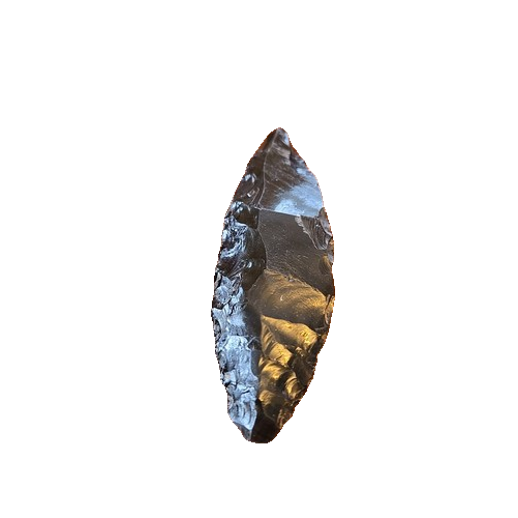
Arrowhead type
Excelsior Point
ExcelsiorCoastal Contracting Stem Cluster3,000 - 1,500 B.P.Transitional Archaic11 reference photos
Key facts
- Age
- 3,000 - 1,500 B.P.
- Cultural period
- Transitional Archaic
- Size
- Medium to Large
- Shape
- Contracting Stem to Ovoid
- Material
- Agate
- Glacial period
- Neoglacial to Roman Warm
More from the Archaic period
Description
This ovoid point exhibits a distinctive morphology, characterized by a medium to large size and an elliptical cross-sectional profile. The blade's curvature is pronounced, with an excurvate shape that tapers inward at the tip and converges at the shoulder edges. Serrations are a prevalent feature on this point type. The shoulders are either faintly defined or absent, transitioning into a contracting stem. The overall outline often resembles a leaf, with a seamless junction between the blade and the hafting area. The base of the point is marked by a convex shape. In terms of manufacture, this type is typically produced through an initial stage of primary percussion flaking, followed by pressure flaking to refine the blade and stem. The resulting flaking pattern is often random, although it can also exhibit chevron or oblique patterns, showcasing the variability in the manufacturing technique.
Size
The dimensions of the arrowheads are as follows: they range in overall length from 41 to 96 mm, with a maximum blade width spanning 21 to 29 mm, and exhibit a thickness of 7 to 12 mm.
Distribution
This style is mainly discovered along the northern coastline mountains, the San Francisco Bay vicinity, and throughout the Delta area. The San Diego Archaeological Center notes its presence extending into San Diego and the northwestern part of Baja California
Additional information
In the realm of Native American archaeology, the Copsey Bi-point is a notable artifact that has been classified as a variant of the Excelsior type point. According to Justice (2002), these points underwent a process of reworking, transforming them into functional tools such as drills or engraving instruments. This secondary use of the Copsey Bi-points highlights the resourcefulness and adaptability of the cultures that created them. Initially, the Houx Contracting Stem points were also categorized alongside the Copsey Bi-points, as indicated by Justice's research in 2002. This early classification underscores the complexities and nuances of archaeological typology, where the evolution of tool forms and functions can often blur the lines between distinct categories. By examining the reworking of Copsey Bi-points, researchers can gain valuable insights into the technological and cultural practices of the societies that produced them.
Identified by
- Named by
- David A. Fredrickson
- Year
- 1973
Similar types
Types that are easy to confuse with the Excelsior point.
- Agate Basin
- Cascade
- Copsey
- Early Leaf
- Tulare Lake Bi-Point
Other types in the Coastal Contracting Stem Cluster
- Ano Nuevo
- Channel Islands Barbed
- Houx Contracting Stem
- Point Sal Barbed
- Vandenberg Contracting Stem