
Arrowhead type
Xil Point
XilNorthern Pacific Stemmed Cluster10,200 - 8,900 B.P.Transitional Paleo to Early Archaic4 reference photos
Key facts
- Age
- 10,200 - 8,900 B.P.
- Cultural period
- Transitional Paleo to Early Archaic
- Size
- Medium to Large
- Shape
- Ovoid to Contracting Stem
- Glacial period
- Late Pleistocene to Early Holocene
Description
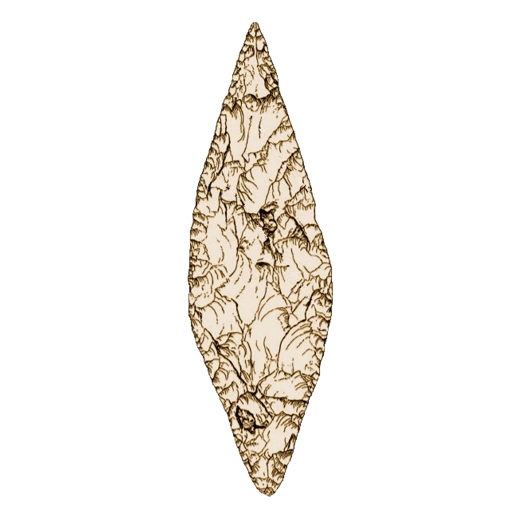
This stone point exhibits a distinctive morphology, characterized by a medium to large size and an ovoid to contracting stem shape, with a cross-sectional profile that is elliptical in outline. The blade portion is notable for its excurvate shape, which may be accompanied by beveling, a technique that involves the removal of small flakes to create a angled edge. The stem, which comprises approximately one-third to one-half of the overall length, is slender and elongated, often featuring beveling with minimal to no grinding evident. The basal edge varies in shape, ranging from a pointed to a convex configuration. The flaking pattern observed on this point is random, indicating a lack of deliberate, organized flake removal during its manufacture.
Size
The dimensions of the arrowheads are as follows: they range in length from 65 to 114 mm, with stem lengths varying between 26 and 63 mm. The width of the blade measures between 26 and 38 mm, although it is worth noting that this particular measurement is derived from a limited dataset.
Distribution
This specimen was discovered at the K1 cave and Gaadu Din 2 Cave in Alaska. It appears in southwestern Alaska, extending into the northwestern regions of Yukon and British Columbia. The complete range remains uncertain
Additional information
During excavations at On Your Knees Cave, a notable discovery was made at the main entrance, where a collection of arrowheads was unearthed in close proximity to OYKC Stemmed points. This finding, documented by Dixon in 2011, provides valuable insight into the cultural and technological practices of the individuals who inhabited this site. The co-occurrence of these distinct point styles suggests a complex and potentially dynamic tool kit, highlighting the resourcefulness and adaptability of the people who created and utilized these artifacts.
The association of these arrowheads with OYKC Stemmed points at the cave's main entrance is particularly significant, as it implies a degree of continuity and overlap between different technological traditions. This overlap may reflect the exchange of ideas, the migration of populations, or the evolution of local tool-making practices over time. By examining the characteristics and distribution of these points, researchers can gain a deeper understanding of the social, economic, and environmental contexts in which they were produced and used.
The discovery of these arrowheads at On Your Knees Cave contributes to a broader understanding of the region's archaeological record, shedding light on the lives and activities of the individuals who created them. As researchers continue to analyze and interpret these findings, they may uncover further insights into the cultural, technological, and historical significance of this site, ultimately enriching our knowledge of the complex and diverse heritage of Native American communities.
Identified by
- Named by
- Daryl W. Fedje
- Year
- 2011
- Type site
- Richardson Island
Similar types
Types that are easy to confuse with the Xil point.
- Cascade Shouldered
- Duke Point Diamond
- Taan
- OYKC Stemmed
- Yukon Bi-point
- Yukon Constricting Stem
- Yukon Small Tang