
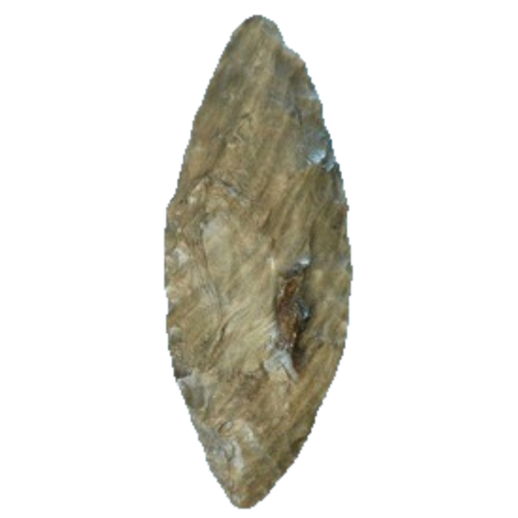
Arrowhead type
Cascade Knife
Cascade Knife8,000 - 5,000 B.P.Early Archaic to Middle Archaic40 reference photos
Key facts
- Age
- 8,000 - 5,000 B.P.
- Cultural period
- Early Archaic to Middle Archaic
- Culture
- Old Cordilleran Culture
- Size
- Medium to Large
- Shape
- Ovoid
- Material
- Obsidian
- Glacial period
- Middle Holocene
More from the Archaic period
Description
This blade exhibits a robust, ovoid silhouette with a medium to large size profile, characterized by an elliptical cross-sectional shape. Its excurvate morphology is marked by a distinctive curvature, where the tip tapers inward and the base sweeps outward in a gentle arc. While the base is predominantly convex, variations may present a straight or tapered termination. Notably, the basal and hafting areas lack evidence of grinding, suggesting a distinct manufacturing approach. The flaking pattern observed on this specimen is randomized, without a discernible order or sequence. Furthermore, the blade often displays beveling, a consequence of repeated re-sharpening processes that have redefined its cutting edge.
Size
The dimensions of the arrowheads are characterized by the following measurements: overall length ranges from 39 to 190 mm, with a mean length typically falling between 70 and 85 mm. The width of the blade spans from 20 to 49 mm, averaging between 28 and 34 mm. In terms of thickness, the arrowheads measure between 5 and 12 mm.
Distribution
This type is mainly located in the Columbia Plateau region of Washington and Oregon, stretching into northern Idaho and western Montana. It is also discovered throughout the Cascade Mountains and into the northern Sierra Nevada mountains of California and Nevada. Additionally, it can be discovered in the Okanagan Mountains of British Columbia, reaching the coastal areas
Mainly found in
Additional information
The arrowheads in question exhibit characteristics reminiscent of the large Cascade type, a category of artifacts that served a dual purpose as both projectile points and knives. A notable feature of Cascade type artifacts is their distinctive blade size, which, when combined with the re-sharpening technique, facilitates classification. Specifically, the removal of short, steep flakes from the blade, resulting in a beveled edge, is a key factor in identifying a Cascade type artifact. However, it is essential to note that larger, unmodified examples may not display this characteristic, as they have not undergone re-sharpening. This lack of modification can lead to classification challenges, as these larger specimens may be categorized under their true type, rather than being grouped with the Cascade type. This complexity highlights the need for careful analysis and consideration of multiple factors when classifying these artifacts.
The re-sharpening technique employed on Cascade type artifacts is a significant aspect of their morphology. The removal of short, steep flakes, which creates a beveled edge, is a deliberate process that not only maintains the artifact's sharpness but also contributes to its distinctive appearance. This technique is a testament to the ingenuity and resourcefulness of the individuals who crafted these artifacts, as it allows for the extension of the tool's useful life. Furthermore, the fact that larger, unmodified examples may be classified differently underscores the importance of considering the artifact's entire lifecycle, from manufacture to use and potential re-sharpening.
The classification of Cascade type artifacts is, therefore, a nuanced process that requires a thorough understanding of their morphological characteristics, as well as the cultural and historical context in which they were created. By examining the size and shape of the blade, the re-sharpening technique, and other diagnostic features, archaeologists can gain valuable insights into the lives and technologies of the individuals who crafted and used these artifacts. Ultimately, a comprehensive understanding of Cascade type artifacts contributes to a richer understanding of the cultural and technological developments of the regions in which they were found, highlighting the significance of these artifacts as a window into the past.
Similar types
Types that are easy to confuse with the Cascade Knife point.
- Agate Basin
- Early Leaf
- Excelsior
- Embarras Bi-point
- Haskett
- Wahmuza
- Wildcat Canyon