
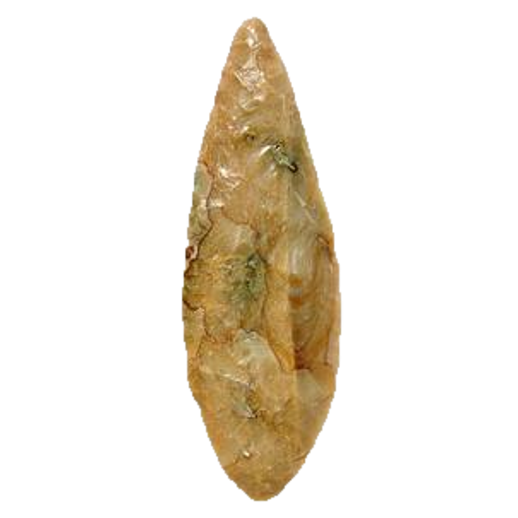
Arrowhead type
Cascade Ovoid Point
Cascade Ovoid8,000 - 5,000 B.P.Early Archaic to Middle Archaic6 reference photos
Key facts
- Age
- 8,000 - 5,000 B.P.
- Cultural period
- Early Archaic to Middle Archaic
- Culture
- Old Cordilleran Culture
- Size
- Medium to Large
- Shape
- Ovoid
- Glacial period
- Middle Holocene
More from the Archaic period
Description
This ovoid point exhibits a slender profile, ranging from medium to large in size, with a cross-sectional shape that is broadly elliptical. In thicker specimens, a subtle median ridge may be present. The blade's curvature is characterized by an excurvate shape, where the edges converge at the tip and then recurve outward at the base, resulting in a tapered hafting area. Serrations often adorn the blade's edges. Notably, the hafting region typically lacks evidence of grinding. The base of the point is marked by a convex curve. The flaking pattern on this point can display a range of styles, including parallel oblique, collateral, or random arrangements, highlighting the variability in flaking techniques employed in its manufacture.
Size
The arrowheads exhibit a range of dimensions, with overall lengths spanning 25 to 90 mm, and averaging between 45 to 60 mm. The blade widths vary from 11 to 30 mm, with a typical range of 11 to 18 mm. In terms of thickness, the arrowheads measure between 3 to 9 mm.
Distribution
This type is mainly located in the Washington and Oregon Columbia Plateau region, stretching into northern Idaho and western Montana. It is also discovered throughout the Cascade Mountains, reaching the northern Sierra Nevada mountains of California and Nevada. Additionally, it can be discovered in the Okanagan Mountains of British Columbia, and further extends to the coastal areas
Mainly found in
Additional information
In the realm of Native American arrowheads, the Cascade point presents a notable challenge in terms of identification, particularly when compared to its Agate Basin counterpart, especially in the eastern reaches of its distribution. Notwithstanding this difficulty, the Cascade point is widely regarded as the predominant late Paleo to early Archaic point type found in western Montana. However, distinguishing between Cascade and Agate Basin points can be a daunting task, unless the discovery is made within a site boasting robust stratification and reliable radiocarbon dating, as highlighted by Sturtevant and Walker in their 1986 study.
The evolutionary trajectory of the Cascade point is believed to have originated from the Agate Basin point, eventually giving rise to other distinct types, including the Cold Spring, Bitterroot, and Salmon River Side Notch points. A closer examination of Cascade points reveals that some specimens may exhibit a straight or concave base, bearing a resemblance to the Humboldt type point. A key characteristic that sets these two point types apart is the presence or absence of grinding on the hafting region. Specifically, Humboldt points are distinguished by heavy grinding in this area, whereas Cascade points typically lack such grinding, providing a crucial diagnostic feature for archaeologists seeking to accurately identify and classify these artifacts.
The distinction between Cascade and Humboldt points underscores the importance of meticulous analysis and attention to detail in the field of archaeology. By recognizing the subtle yet significant differences between these point types, researchers can gain a deeper understanding of the cultural and technological developments that occurred among Native American communities in western Montana during the late Paleo to early Archaic periods. Furthermore, the study of Cascade points and their evolutionary relationships with other point types offers valuable insights into the dynamic and complex history of Native American cultures in the region, highlighting the need for continued research and exploration into the rich archaeological heritage of North America.
Identified by
- Named by
- B. Robert Butler
- Year
- 1961
Similar types
Types that are easy to confuse with the Cascade Ovoid point.
- Agate Basin
- Early Leaf
- Excelsior
- Haskett
- Lochnore Lanceolate
- Mahkin
- Mauer Ovoid
- Mayne Island
- Need
- Owl Cave
- Parman
- Shuswap Lanceolate
- Spedis
- Steamboat
- Wildcat Canyon
- Windust