
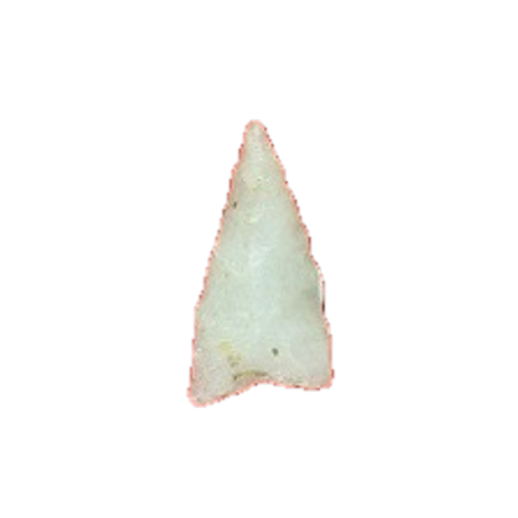
Arrowhead type
Camp Creek Triangle Point
Camp Creek TriangleLate Woodland Triangle Cluster to Early Mississippian Triangle Cluster3,000 - 1,500 B.P.Early Woodland to Middle Woodland11 reference photos
Key facts
- Age
- 3,000 - 1,500 B.P.
- Cultural period
- Early Woodland to Middle Woodland
- Size
- Small to Medium
- Shape
- Triangle
- Material
- Quartz
- Glacial period
- Neoglacial to Roman Warm
More from the Woodland period
Description
This triangular point exhibits a compact to moderate size, characterized by an elliptical profile. Its straight-edged blade may occasionally display subtle curvature, manifesting as either an excurvate or incurvate shape. The base of the point is notable for its concave morphology, sometimes accompanied by basal thinning. The flaking pattern observed on this artifact is irregular and non-directional, lacking a high degree of flaking finesse, which is evident in the overall coarseness of the flake scars.
Size
The arrowheads exhibit a range of dimensions, with total lengths spanning from 35 to 75 mm, although the average length typically falls within a narrower range of 33 to 43 mm. In terms of width, these artifacts measure between 18 and 28 mm, while their thickness varies from 4 to 9 mm, with an average thickness of 7 mm.
Distribution
This type is mainly discovered in the Tennessee River Valley and its surrounding drainage areas. It has also been identified in the foothills of Georgia and South Carolina
Additional information
In a notable observation, Whatley (2002) highlights a key distinction between certain arrowhead points and those characteristic of the Late Woodland period. Specifically, the points in question can be identified by their relatively greater thickness, which sets them apart from the more slender, triangular points typical of the Late Woodland era. Furthermore, the outline of these points lacks the refined, well-defined edges that are commonly associated with Late Woodland period points, instead presenting a more subtle or less pronounced silhouette. This distinction in thickness and outline serves as a crucial diagnostic feature, enabling archaeologists to differentiate between these points and their later, more refined counterparts.
The significance of this distinction lies in its implications for the dating and cultural association of these points. By recognizing the thicker, less refined outline of these points, researchers can more accurately attribute them to a specific cultural and temporal context, rather than mistakenly assigning them to the Late Woodland period. This, in turn, can provide valuable insights into the technological, social, and cultural developments of the societies that produced these points, as well as their place within the broader narrative of Native American archaeological history.
The characteristics of these points, as noted by Whatley (2002), underscore the importance of careful observation and detailed analysis in archaeological research. By attending to subtle variations in form and morphology, scholars can uncover meaningful patterns and distinctions that might otherwise go unnoticed, ultimately enriching our understanding of the complex and diverse cultural landscapes of Native American communities.
Identified by
- Named by
- T.N.M Lewis and Madeline Kneberg
- Year
- 1956
- Type site
- Camp Creek, Greene County, Tennessee
Similar types
Types that are easy to confuse with the Camp Creek Triangle point.