
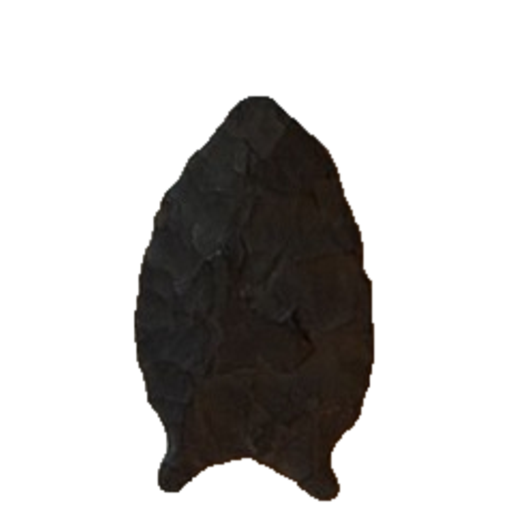
Arrowhead type
Rodgers Side Hollow Point
Rodgers Side Hollow10,000 - 8,000 B.P.Transitional Paleo to Early Archaic9 reference photos
Key facts
- Age
- 10,000 - 8,000 B.P.
- Cultural period
- Transitional Paleo to Early Archaic
- Size
- Medium to Large
- Shape
- Auriculate to Lanceolate
- Glacial period
- Early Holocene
Description
This auriculate point exhibits a medium-thin profile, characterized by a flattened cross-sectional morphology. The blade edge can display a range of curvature, from straight to distinctly excurvate. The shoulders are often subdued or entirely absent, and when present, are positioned at an upward inclination. The stem expands in width, while the base is marked by a deep concavity that forms pronounced auricles. The base is thinned through the removal of multiple channel flakes, typically two or three, which can extend upwards onto the point's face. Many specimens of this point type feature fluting, and basal grinding is a common attribute. The flaking pattern on this point is random, lacking a discernible order or orientation.
Size
The dimensions of the arrowheads are as follows: they range in total length from 40 to 70 mm, with blade widths spanning 21 to 34 mm. The narrowest sections, specifically the neck or waist, measure between 16 to 25 mm, while the basal widths fall within the range of 16 to 26 mm.
Distribution
This type is mainly discovered in the central to eastern regions of Texas, extending into eastern Oklahoma, southwestern Arkansas, and northwestern Louisiana
Additional information
The arrowhead in question is classified as a variant of the San Patrice type, a distinct category of projectile points that have been extensively studied in the field of archaeology. This classification is significant, as it provides valuable insights into the cultural and technological practices of the Native American groups that crafted these artifacts. The San Patrice variant is characterized by a unique combination of morphological and stylistic features, which set it apart from other types of arrowheads found in North America.
Further examination of this variant can reveal a wealth of information about the historical context in which it was created, including the time period, geographic location, and cultural associations. By analyzing the San Patrice variant, archaeologists can gain a deeper understanding of the technological, social, and economic dynamics that shaped the lives of Native American communities. The study of such artifacts is crucial for reconstructing the past and shedding light on the complexities of human history.
It is essential to note that the San Patrice variant is a specific type of arrowhead, and its classification is based on a set of well-defined criteria. Archaeologists use a range of methods, including morphometric analysis and stylistic comparison, to identify and categorize these artifacts. By doing so, they can build a more comprehensive picture of the cultural and historical contexts in which these arrowheads were created and used. The San Patrice variant is an important part of this larger narrative, offering a unique window into the lives and traditions of Native American communities.
Identified by
- Year
- 1978
- Type site
- Rex Rodgers Site, Mackenzie Reservoir, Briscoe County, Texas
Similar types
Types that are easy to confuse with the Rodgers Side Hollow point.
- Albany
- Dalton
- Palmer
- Pelican
- Golondrina
- San Patrice Keithville
- San Patrice Geneill
- San Patrice Hope
- San Patrice Leaf River
- San Patrice St. Johns