
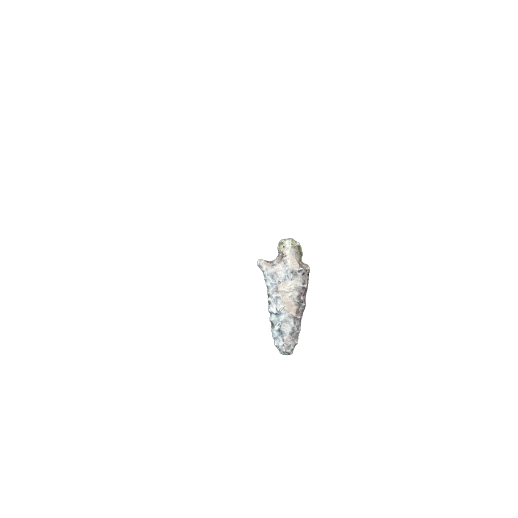
Arrowhead type
Alba Barbed Point
Alba BarbedAlba Cluster1,200 - 800 B.P.Late Paleo to Transitional Archaic11 reference photos
Key facts
- Age
- 1,200 - 800 B.P.
- Cultural period
- Late Paleo to Transitional Archaic
- Culture
- Caddo Culture
- Size
- Small to Medium
- Shape
- Expanding Stem
- Glacial period
- Medieval Warm to Little Ice Age
Description
This diminutive point, typically measuring approximately 1 inch in length, exhibits a triangular form with a broadening stem. Its cross-sectional profile is characterized by a flat elliptical shape. The blade's curvature can range from slightly outwardly curved (excurvate) to inwardly curved (recurvate), with a notable widening towards the shoulder area. Fine serrations often adorn the blade's edge. The shoulders themselves are oriented horizontally, forming a stark contrast to the expanding stem, which features a convex base that imparts a distinctive bulbous or fan-like shape. The flaking pattern observed on this point is random, lacking a discernible order or sequence.
Size
The arrowheads exhibit a range of dimensions, with overall lengths spanning 18 to 35 mm. The stem, which accounts for approximately 1/5 to 1/4 of the total length, measures 7 mm. In terms of width, the arrowheads are 1.3 to 1.6 mm, while the stem width ranges from 5 to 8 mm, as documented by Suhm and Krieger (1954).
Distribution
This type is mainly discovered in the Caddoan areas of the Red River Valley spanning Texas, Oklahoma, Arkansas, and Louisiana, and extending to the coastal areas of Texas and Louisiana. It is also located in the mid Mississippi River valley, albeit less commonly, and reaches into central Texas
Additional information
In the realm of Native American archaeology, a notable observation has been made regarding the discovery of certain arrowhead types. Specifically, it has been observed that these artifacts are often found in association with Hayes points, which are a distinct type of projectile point. The presence of these arrowheads in caches alongside Hayes points suggests a cultural or functional connection between the two, highlighting the importance of considering the broader archaeological context in which these artifacts are found.
The co-occurrence of these arrowheads with Hayes points in caches implies a level of intentional placement or storage, which can provide valuable insights into the technological, social, and economic practices of the cultures that created and utilized these artifacts. By examining the characteristics and distribution of these arrowheads in relation to Hayes points, researchers can gain a deeper understanding of the cultural dynamics and exchange networks that existed among Native American communities.
Further study of these caches and their contents can shed light on the significance of Hayes points and associated arrowheads, offering a more nuanced perspective on the lives and traditions of the people who crafted and used these artifacts. The discovery of these artifacts in caches serves as a testament to the ingenuity and resourcefulness of Native American cultures, and continued research in this area has the potential to reveal new information about the historical context and cultural significance of these important archaeological finds.
Identified by
- Named by
- Alex D. Krieger
- Year
- 1946
- Type site
- Multiple sites around Alba, Wood County, Tx
Similar types
Types that are easy to confuse with the Alba Barbed point.