
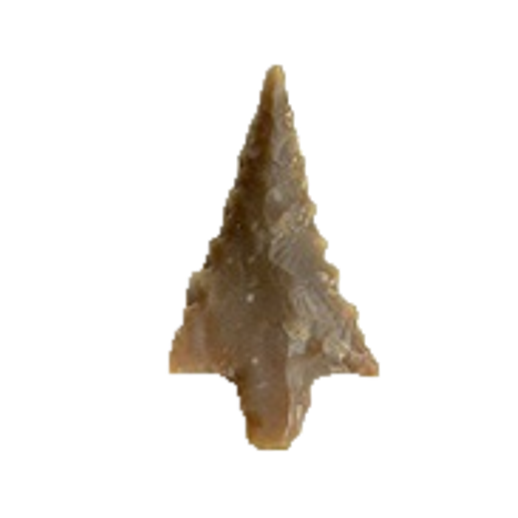
Arrowhead type
Bonham Point
Bonham1,200 - 400 B.P.Mississippian to Late Prehistoric9 reference photos
Key facts
- Age
- 1,200 - 400 B.P.
- Cultural period
- Mississippian to Late Prehistoric
- Size
- Small
- Shape
- Straight Stem to Contracting Stem
- Material
- Pottery
- Glacial period
- Little Ice Age
More from the Mississippian, Late Prehistoric periods
Description
This triangular stemmed point exhibits a slender profile, measuring between 0.75 and 1.75 inches in length, with a cross-sectional shape that ranges from elliptical to flattened. The blade itself is narrow and can display a variety of curvature, including straight, incurvate, or recurvate forms, often with a pronounced flare at the shoulder edge. A notable feature of many specimens is the presence of fine serrations along the blade edge. The shoulders are clearly delineated and can assume a range of orientations, from horizontal to downward-sloping or slightly barbed. The stem, typically narrow and rectangular in shape, usually presents a straight configuration, although some examples may exhibit a slight expansion. The base of the point is characterized by a straight edge. Overall, the craftsmanship of this point type is often of high quality, with a flaking pattern that appears random and unstructured.
Size
The dimensions of the arrowheads are characterized by a total length ranging from 20 to 45 mm, with the stem portion measuring between 5 to 7 mm in length. The overall width spans from 10 to 18 mm, while the stem width is narrower, falling within the range of 3 to 5 mm, as outlined by Suhm and Krieger (1954).
Distribution
This artifact is mainly located in the Red River Valley of northern to northeast Texas and southwest to northwest Louisiana. It can also be discovered in southwest Arkansas and southeast Oklahoma (red). On occasion, it has been spotted in the Pecos River basin of western Texas, extending into eastern New Mexico (yellow)
Mainly found in
Additional information
In the realm of Native American arrowheads, a distinct point type bears a resemblance to the Alba point, yet exhibits notable differences in its morphology. Characterized by a narrower blade and stem, this point type is distinguished by its primarily straight edge profile, which contrasts with the more curved or recurved edges often seen in other specimens (Suhm and Krieger, 1954). This unique combination of traits sets it apart from other point types, highlighting the diversity of arrowhead designs crafted by ancient cultures.
The classification of this point type has been further refined by Shafer (2006), who proposed a Bonham-Alba classification that encompasses a range of specimens dating back to around A.D. 100. This classification is significant, as it underscores the geographic and temporal scope of this point type, which spans from Central Texas to East Texas. By recognizing the Bonham-Alba classification, researchers can better understand the cultural and technological exchange networks that existed among Native American groups in this region during the early centuries of the Common Era.
The Bonham-Alba point type offers valuable insights into the lives and traditions of the Native American communities that crafted these arrowheads. The attention to detail and craftsmanship evident in these points reflect the importance of hunting and warfare in the cultural and economic practices of these societies. As archaeologists continue to study and contextualize these artifacts, they can gain a deeper understanding of the complex historical dynamics that shaped the lives of Native American communities in Texas and beyond, ultimately enriching our appreciation for the rich cultural heritage of these regions.
Identified by
- Named by
- Alex D. Krieger
- Year
- 1946
- Type site
- Sanders Site, Fannin County, Texas
Similar types
Types that are easy to confuse with the Bonham point.