
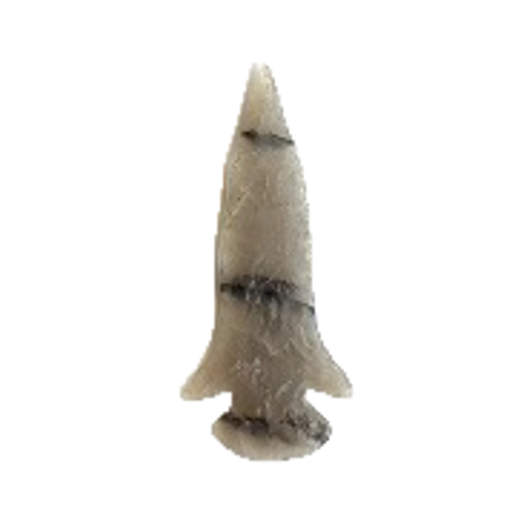
Arrowhead type
Agee Point
AgeeAlba Cluster1,000 - 700 B.P.Late Archaic30 reference photos
Key facts
- Age
- 1,000 - 700 B.P.
- Cultural period
- Late Archaic
- Culture
- Coals Creek Culture and Caddoan Culture
- Size
- Small to Medium
- Shape
- Corner Notch
- Glacial period
- Medieval Warm
More from the Archaic period
Description
This corner-notched point exhibits a slender profile, with a medium size range and a cross-sectional shape that is notably flattened. The blade's curvature is predominantly recurvate, although some specimens, particularly those of smaller dimensions, may display a straighter configuration. A distinctive feature of this point is the excurvate tip, often accompanied by parallel edges that flare outward at the shoulder, creating a pronounced shoulder edge. The notches that define the corner of the point are deep and enter the blade at a 45-degree angle, typically forming a U- or V-shaped pattern. The shoulders are barbed, with terminations that can vary from squared to rounded or pointed. The stem expands outward, terminating in a convex base that exhibits a fan-shaped or bulbous morphology, rarely featuring multiple notches. The point's fabrication is characterized by meticulous pressure flaking, with flaking patterns that range from oblique, commonly observed on larger specimens, to random, more typically seen on smaller examples, underscoring the high level of craftsmanship that defines this artifact.
Size
The dimensions of the arrowheads are as follows: they range in overall length from 13 to 55 mm, with a typical length of 25 to 35 mm. The stem measures between 5 to 8 mm in length. At the shoulders, the blade width varies from 10 to 25 mm, averaging 15 mm. The neck width is between 5 to 8 mm, while the stem width ranges from 8 to 15 mm. In terms of thickness, the arrowheads measure between 2 to 4 mm.
Distribution
This type is mainly discovered at Late Coles Creek locations in southern Arkansas and eastern Texas, extending to the Spiro site in Oklahoma's LeFlore County. They are also known to occur in northern parts of Louisiana.
Additional information
Bearing a resemblance to the Homan point, yet distinguishable by its flat-tipped barb, a characteristic commonly associated with the Agee point (Turner and Hester, 1985). This unique feature has sparked intriguing discussions among archaeologists, with Davis (1995) proposing that these points may have served a ceremonial purpose, given their discovery in caches linked to burial sites. The similarity between Agee and Homan points has led Davis to suggest that they may be part of a continuous spectrum, exhibiting a high degree of visual overlap.
Further insights into the significance of these points have been offered by James A. Brown (1976), who posits that they may represent a "socio-technic point" of the Spiro phase and earlier periods. This interpretation implies that these points were crafted not solely for functional use, but also for social or ceremonial purposes. Brown's analysis also extends to the late Coles Creek culture, where these socio-technic points were likely created for non-utilitarian purposes, underscoring the complex and multifaceted role of these artifacts in the cultural and spiritual practices of their creators.
The study of these points highlights the importance of considering the broader cultural context in which they were produced and used. By examining the formal characteristics, distribution, and association of these points with other archaeological finds, researchers can gain a deeper understanding of the technological, social, and symbolic dimensions of Native American cultures. The Agee point, in particular, offers a fascinating case study, inviting further investigation into the intersections of technology, ritual, and social identity in the lives of ancient American communities.
Identified by
- Named by
- W. Raymond Wood
- Year
- 1963
- Type site
- Crenshaw Mount, Miller County, Arkansas
Similar types
Types that are easy to confuse with the Agee point.
- Alba
- Catahoula
- Dardanelle
- Hayes
- Homan
- Hughes
- Keota
- Penwah Slough
- Rockwall