
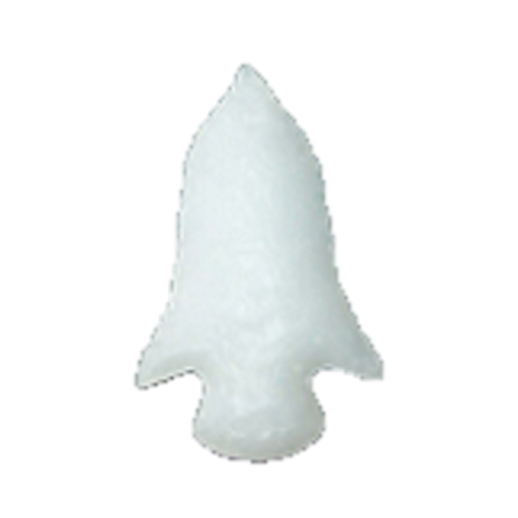
Arrowhead type
Homan Point
HomanAlba Cluster1,000 - 700 B.P.Late Prehistoric to Mississippian10 reference photos
Key facts
- Age
- 1,000 - 700 B.P.
- Cultural period
- Late Prehistoric to Mississippian
- Culture
- Caddoan Culture
- Size
- Small
- Shape
- Expanding Stem to Corner Notch
- Glacial period
- Medieval Warm
More from the Mississippian, Late Prehistoric periods
Description
This diminutive point exhibits a distinctive morphology, characterized by a stem that broadens outward, accompanied by a blade that curves inward, terminating in a sharp, tapering apex. The lateral edges of the blade may display delicate serrations, while the shoulders can range from a horizontal orientation to a subtly hooked configuration. The notches, which penetrate the point from the corners at an angle of approximately 45 to 90 degrees, create a pronounced, V- or U-shaped indentation. The stem's shape can vary, with most examples displaying an expanding form, although some instances may feature a straight stem. The base of the point is carefully thinned, assuming a convex profile that imparts a fan-like or bulbous appearance. The manufacture of this point involved the application of pressure flaking, resulting in a flaking pattern that lacks a discernible order or arrangement, instead presenting a random, irregular texture.
Size
The arrowheads exhibit a range of dimensions, with overall lengths spanning 15 to 40 mm, and averaging between 25 to 30 mm. The stem, which comprises approximately 1/5 to 1/4 of the total length, measures between 5 to 7 mm. The neck width varies from 3 to 6 mm, while the stem width ranges from 6 to 9 mm. In terms of thickness, the arrowheads measure between 2 to 5 mm.
Distribution
This type is mainly discovered in the southeast region of Oklahoma and extends into the northeast portion of Texas, northern Louisiana, and Arkansas
Additional information
In the realm of Native American arrowhead typology, the Agee point has been a subject of interest among archaeologists. Notably, Perino's 1968 study suggests that a particular variation of the Agee point is more commonly encountered, often found in conjunction with other similar points. A key distinguishing feature of this variant, referred to as the Alba type, is the absence of a needle-like point and a flat-tipped barb, which are characteristic of other point types.
Further research by Davis in 1995 sheds light on the relationship between the Homan point and the Agee point, highlighting their similarities in overall appearance. Davis proposes that these two point types may be part of a continuum, implying a possible evolutionary or stylistic link between them. This observation underscores the complexity and nuance of Native American arrowhead classification, where subtle variations in form and design can reveal significant insights into the cultural and technological practices of ancient societies.
The study of these point types, including the Agee and Homan points, contributes to a deeper understanding of the technological and cultural developments of Native American communities. By examining the characteristics and distribution of these artifacts, archaeologists can reconstruct the historical context in which they were created and used, ultimately enriching our knowledge of the lives and traditions of these ancient cultures. The Alba type, in particular, offers a fascinating case study in the diversity and adaptability of Native American arrowhead design, inviting further research and analysis to uncover the stories behind these enigmatic artifacts.
Identified by
- Named by
- Raymond Wood
- Year
- 1963
- Type site
- Crenshawn Site, Miller County, Arkansas
Similar types
Types that are easy to confuse with the Homan point.
Other types in the Alba Cluster
- Agee
- Alba