
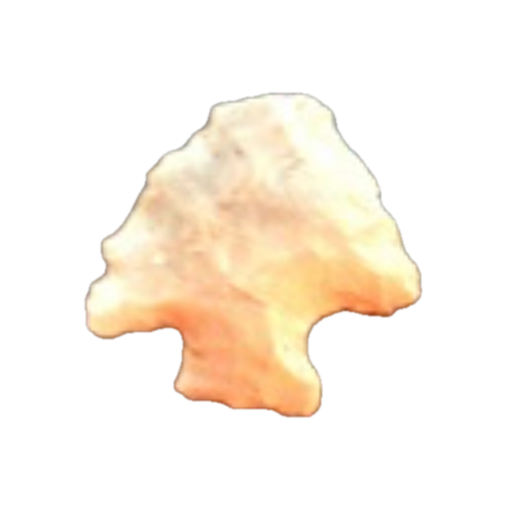
Arrowhead type
Colbert Point
Colbert1,050 - 420 B.P.Late Prehistoric2 reference photos
Key facts
- Age
- 1,050 - 420 B.P.
- Cultural period
- Late Prehistoric
- Size
- Small
- Shape
- Expanding Stem to Straight Stem
- Glacial period
- Roman Warm to Little Ice Age
More from the Late Prehistoric period
Description
This triangular point exhibits a distinctive morphology, characterized by an elliptical cross-sectional profile. The blade edge can display a range of curvature, from straight to recurvate, with a pronounced inward curve at the apex and an outward flare at the shoulder. The shoulder morphology is variable, spanning from horizontal to barbed configurations. The stem typically expands, although some specimens may exhibit a straight stem. The basal edge is generally straight, with occasional instances of slight convexity. The flaking pattern on this point is characterized by a random, non-patterned arrangement of flake scars.
Size
The dimensions of the arrowheads are as follows: they exhibit a total length ranging from 20 to 35 mm, with the stem portion measuring between 4 to 7 mm in length. The blade itself spans a width of 10 to 20 mm, while the neck width is narrower, falling within the range of 5 to 9 mm. The stem width is measured at 1 to 11 mm, notable for being 1 to 3 mm wider than the neck width.
Distribution
This type is mainly discovered in easternmost Texas, westernmost Louisiana, southernmost Arkansas and extending into easternmost Oklahoma.
Additional information
In the realm of Native American arrowhead typology, a particular point has been frequently misidentified as a Homan point, a classification initially proposed by Turner and Hester in 1985. However, a closer examination reveals that this point lacks the distinctive bulbous stem characteristic of the Homan type, setting it apart from this category. Instead, its morphology bears a resemblance to the Alba type, although a notable difference lies in the presence of barbed and flared shoulders in the former, a feature not typically associated with the Alba type, as highlighted by Davis in 1995.
A review of the literature reveals that this point type was not discussed in the 2011 publication by Turner et al., sparking speculation that its validity as a distinct type may no longer be recognized, as suggested by Moore in 2015. This omission is noteworthy, as it may indicate a shift in the scholarly understanding of this point's classification and significance within the context of Native American archaeology. The distinction between this point and other types, such as the Alba and Homan, underscores the complexity and nuance of arrowhead typology, highlighting the need for careful analysis and consideration of morphological characteristics in the classification and interpretation of these artifacts.
The study of Native American arrowheads, including this particular point type, offers valuable insights into the technological, cultural, and historical contexts of the communities that created them. By examining the characteristics of these artifacts, researchers can gain a deeper understanding of the lives and traditions of Native American groups, as well as the evolution of their technological and artistic practices over time. As such, continued research and refinement of arrowhead typology are essential for advancing our knowledge of Native American archaeology and promoting a more nuanced appreciation of the cultural heritage of these communities.
Identified by
- Named by
- Clarence W. Webb
- Year
- 1963
- Type site
- Colbert site, Bienville Parish, Louisiana
Similar types
Types that are easy to confuse with the Colbert point.
Other types in this cluster
- Bundick