
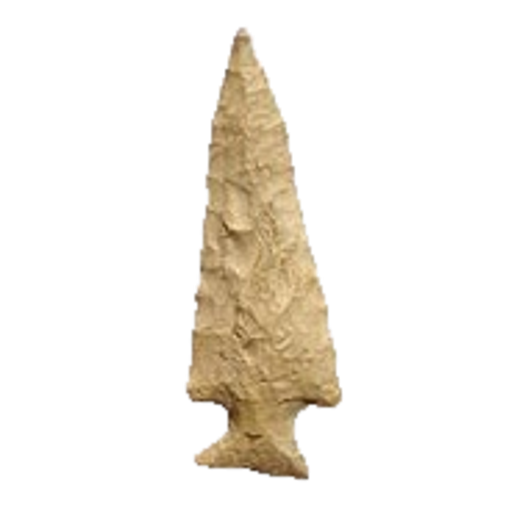
Arrowhead type
Scallorn Point
ScallornScallorn Cluster1,300 - 500 B.P.Late Woodland to Mississippian36 reference photos
Key facts
- Age
- 1,300 - 500 B.P.
- Cultural period
- Late Woodland to Mississippian
- Size
- Small
- Shape
- Corner Notch to Side Notch
- Glacial period
- Roman Warm to Little Ice Age
More from the Woodland, Mississippian periods
Description
This triangular point exhibits a slender profile with a corner notch, characterized by a flattened cross-sectional morphology. The blade edge is generally straight, although some specimens may display a subtle excurvate curvature, while others, particularly those with flaring shoulder edges, may exhibit an incurvate shape. Blade width can vary significantly, ranging from broad to narrow, and often features serrations. The shoulders are typically barbed, constituting a key diagnostic trait, although some examples may present with squared shoulders instead. The stem expands downward, terminating in a base that can be either straight or convexly curved. The flaking pattern on this point is random, lacking a discernible order or organization.
Size
The dimensions of the arrowheads are characterized by the following measurements: overall length ranges from 25 to 45 mm, with a mean length of 35 mm not being specified but an average of 23 mm being noted for a related but possibly distinct parameter, while the stem comprises between 1/7 and 1/3 of the total length, spanning 5 to 9 mm. The blade's width varies between 13 and 21 mm, averaging 16 mm. Additionally, the neck width and stem width are measured at 5 to 11 mm and 7 to 18 mm, respectively. The thickness of the arrowhead is recorded between 2 and 5 mm, with an average thickness of 5 mm being reported, although this may be an error given the range.
Distribution
This type is predominantly located in the central region of Texas, spanning the Red River Valley across Texas, Oklahoma, Louisiana, and Arkansas. The occurrence rate diminishes as you move south into Tamaulipas, Nuevo Leon, and Coahuila. It appears with reduced regularity in the remaining designated zones
Additional information
In the realm of Native American archaeology, the Sequoyah point has undergone significant classification refinement since its initial identification. Originally categorized by Bell in 1960, it wasn't until the excavation at the Williams Shelter site in Missouri that the distinctive characteristics of this point type became apparent, ultimately leading to its formal designation by James Brown in 1968. Distinguishing the Sequoyah point from similar types can be a challenging task, owing to the subtle variations in their morphology. However, the Sequoyah point is typically marked by its deeply serrated edges, elongated blade shape, and a narrower hafting region accompanied by wider notches, as noted by Justice in 1987.
The Sequoyah point is closely related to the Crisp Ovate point, which is believed to have served as a preform for both the Scallorn and Sequoyah points, according to Justice's 1987 research. This connection highlights the complex and nuanced nature of Native American lithic technology, where point types often evolved from one another through subtle modifications. The Scallorn Stemmed point, in particular, is notable for its association with the Austin Focus, a cultural designation employed by Kelley. Although Kelley's work did not provide a detailed description of the Scallorn Stemmed point, subsequent research by Miller and Jelks in 1952, as well as a comprehensive description by Suhm and Krieger in 1954, has significantly enhanced our understanding of this point type.
The detailed descriptions of the Sequoyah point and its related types underscore the importance of meticulous archaeological analysis in uncovering the intricacies of Native American cultural and technological development. By examining the subtle variations in point morphology, researchers can reconstruct the complex historical contexts in which these artifacts were created and used. The Sequoyah point, with its distinctive serrated edges and elongated blade shape, serves as a testament to the ingenuity and craftsmanship of Native American communities, offering a unique window into the lives and traditions of these ancient cultures.
Identified by
- Named by
- J Charles Kelley
- Year
- 1947
- Type site
- The Kyle Site, Hill County, Texas
Similar types
Types that are easy to confuse with the Scallorn point.
Other types in the Scallorn Cluster
- Sequoyah
- Washington