
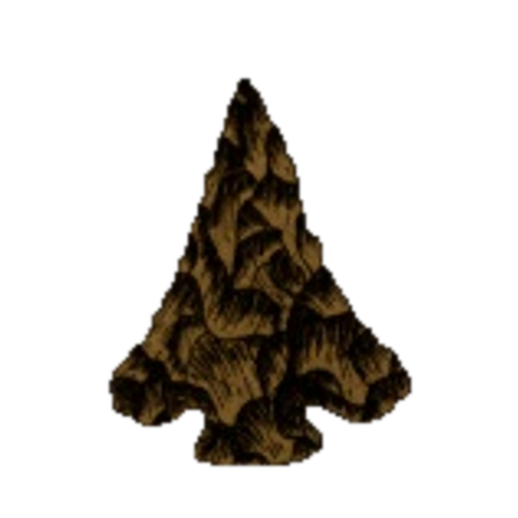
Arrowhead type
Catahoula Point
Catahoula1,300 - 900 B.P.Late Prehistoric10 reference photos
Key facts
- Age
- 1,300 - 900 B.P.
- Cultural period
- Late Prehistoric
- Size
- Small to Medium
- Shape
- Straight Stem to Expanding Stem to Basal Notch to Corner Notch
- Material
- Quartzite
- Glacial period
- Vandal Minimum to Medieval
More from the Late Prehistoric period
Description
This triangular point exhibits a slender profile, characterized by a stemmed to expanding stem morphology. Its cross-sectional shape is flattened, providing a stable platform for the broad, recurvate blade, which tapers inward at the apex and outward at the shoulder, although some variants display a straight-edged blade. The maximum blade width is typically achieved at the shoulder, where large, rounded to squared barbs are present, imparting a distinctive silhouette. The stem, which is generally short, may exhibit a slight or pronounced expansion. The basal edge is predominantly convex, although occasional examples may display a straight or variable configuration. Notably, this point type is often meticulously crafted, featuring a random flaking pattern that underscores the skill of its prehistoric manufacturers.
Size
The dimensions of the arrowheads are as follows: they range in overall length from 18 to 45 mm, with stem lengths varying between 4 and 8 mm. The width of the blade spans from 15 to 30 mm, while the neck width measures between 5 and 10 mm. Additionally, the stem width is recorded to be between 7 and 14 mm.
Distribution
This type is mainly located in the north-central to northeastern regions of Texas, extending into northwestern Louisiana. It can also be discovered in southwestern Arkansas and southeastern Oklahoma
Additional information
In the realm of Native American arrowhead studies, intriguing parallels have been observed between the Catahoula point, predominantly found in the south central region, and the Eastgate point, which is characteristic of the Desert Southwest and Far West regions. A seminal study conducted by Leland W. Patterson in 1976 investigated the distributional patterns of Catahoula points, yielding findings that suggested their presence extended into Nevada. However, subsequent research has failed to corroborate this assertion, leaving the notion unsubstantiated. Notably, a discernible gap appears to separate the geographical distributions of these two point types, prompting speculation about the nature of their similarities.
The resemblance between Catahoula and Eastgate points may be attributed to convergent development, where analogous forms emerged independently in distinct cultural contexts, rather than resulting from the transfer of technological knowledge between the two regions. This interpretation is supported by the lack of concrete evidence indicating a direct exchange of ideas or migration of artisans that could have facilitated the dissemination of point-making techniques. Instead, the similarities may stem from the shared functional requirements and raw material constraints that influenced the design and manufacture of arrowheads across different regions.
The study of these point types offers valuable insights into the complexities of prehistoric cultural exchange and technological evolution. By examining the distribution, morphology, and chronological context of Catahoula and Eastgate points, researchers can gain a deeper understanding of the dynamics that shaped the lives of Native American communities in these regions. Further investigation into the characteristics and dispersal patterns of these arrowhead types may shed light on the intricacies of cultural interaction, innovation, and adaptation in the prehistoric record, ultimately enriching our comprehension of the rich and diverse heritage of Native American cultures.
Identified by
- Named by
- Clarence H. Webb, Hiram F. Gregory, and Robert Bell
- Year
- 1956
- Type site
- Sanson site (16RA ) near Catahoula Lake, Catahoula Parish, Louisiana
Similar types
Types that are easy to confuse with the Catahoula point.