
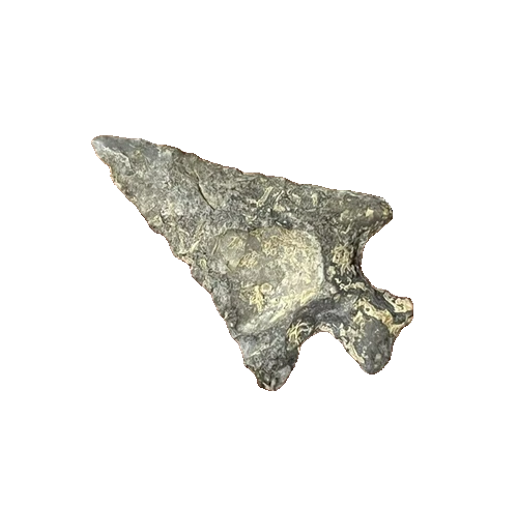
Arrowhead type
Cuney Point
Cuney500 - 200 B.P.Late Prehistoric to Historic7 reference photos
Key facts
- Age
- 500 - 200 B.P.
- Cultural period
- Late Prehistoric to Historic
- Culture
- Hasinai Branch of the Caddoan Culture
- Size
- Small
- Shape
- Expanding Stem to Bifurcated
- Material
- Pottery
- Glacial period
- Little Ice Age
More from the Late Prehistoric, Historic periods
Description
This slender projectile point exhibits a distinctive morphology, characterized by a broadening stem and a flattened profile. The elongated blade, often narrow in width, can display a range of curvature, from recurvate shapes that flare outward at the shoulder, to straight configurations. Notably, the shoulders are consistently barbed, providing a sharp, angled edge. The stem, although relatively short, expands outward, terminating in a base that can be either concave or notched. The craftsmanship of these points is typically of high quality, with a random flaking pattern evident on the surface, suggesting a skilled manufacturing technique.
Size
The dimensions of the arrowheads are characterized by a total length ranging from 20 to 45 mm. The stem, which constitutes between 1/6 and 1/3 of the overall length, provides a proportional basis for measurement. In terms of width, the arrowheads span from 10 to 20 mm, while the stem width specifically measures between 4 and 7 mm, as outlined by Suhm and Krieger (1954).
Distribution
This type is mainly located from the central to eastern regions of Texas, extending into western Louisiana and southwestern Arkansas. It can also be discovered in southern Texas, albeit less often. Sightings have been documented in the Red River valley area. The primary concentration is typically observed in Cherokee, Anderson, and Henderson counties within Texas
Also found, less often, in
Additional information
In the realm of Native American arrowhead typology, the Cuney type is distinguished by its distinctive stem morphology, which exhibits a pronounced expansion towards the base. This characteristic serves as a key differentiator from the Alba type, as noted by Davis in 1995, where the latter typically features a straight or slightly expanding stem. A comparative analysis with the Rockwall type, as discussed by Perino in 1991, reveals that the Cuney type tends to be narrower and less expanded, underscoring the subtle yet significant variations that exist between these closely related arrowhead forms.
The Cuney type's expansive stem base is a notable characteristic that warrants attention, as it reflects the nuanced craftsmanship and design considerations of the Native American cultures that created these artifacts. By examining the morphological differences between the Cuney, Alba, and Rockwall types, researchers can gain valuable insights into the technological, social, and cultural contexts in which these arrowheads were produced and utilized. The meticulous attention to detail and the deliberate design choices evident in these artifacts highlight the importance of continued archaeological study and analysis of Native American material culture.
Through a comprehensive understanding of the Cuney type and its relationships to other arrowhead forms, archaeologists can reconstruct a more detailed and nuanced picture of the lives and traditions of Native American communities, shedding light on their technological, artistic, and cultural achievements. By preserving and interpreting the material record of these cultures, we can work to ensure that their histories and contributions are accurately represented and respected, providing a richer and more inclusive understanding of the complex and diverse heritage of Native American societies.
Identified by
- Named by
- Dee Ann Suhm
- Year
- 1954
- Type site
- Allen site, Cherokee County, Texas
Similar types
Types that are easy to confuse with the Cuney point.