
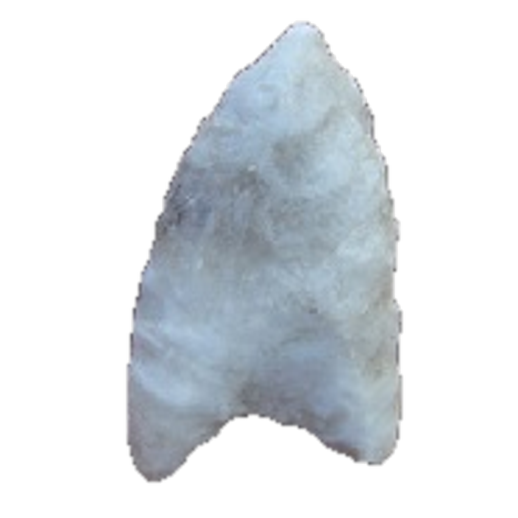
Arrowhead type
Alamance Point
AlamanceDalton Cluster10,000 - 9,000 B.P.Late PaleoKey facts
- Age
- 10,000 - 9,000 B.P.
- Cultural period
- Late Paleo
- Size
- Medium
- Shape
- Auriculate to Lanceolate
- Glacial period
- Early Holocene
More from the Paleo period
Description
This auriculate point exhibits a sturdy, triangular form with a medium thickness, characterized by an elliptical cross-sectional profile. The blade itself is notably broad, displaying a range of edge configurations from straight to excurvate, with some specimens featuring edges that are nearly parallel. A pronounced concavity defines the base of the point. Notable is the extensive grinding evident on the hafting area, indicative of significant preparation for attachment. The flaking pattern observed on this point is random, lacking a discernible order or sequence.
Size
The dimensions of the arrowheads are characterized by a total length ranging from 30 to 80 mm, a width spanning 25 to 40 mm, and a basal concavity measuring between 4 and 9 mm.
Distribution
This type is predominantly located in the Piedmont region of North Carolina, extending into Virginia and South Carolina. It can also be discovered in the coastal areas of these states.
Mainly found in
Additional information
More information needed.
Identified by
- Named by
- Floyd Painter
- Year
- 1963
Similar types
Types that are easy to confuse with the Alamance point.
- Dalton
- Hardaway Dalton
- Yadkin
Other types in the Dalton Cluster
- Beaver Lake
- Dalton Breckenridge
- Dalton Colbert
- Dalton Greenbrier
- Dalton Hemphill
- Dalton Hempstead
- Dalton Nuckolls
- Dalton Sloan
- Hi-Lo
- Quad
- Russell Cave