
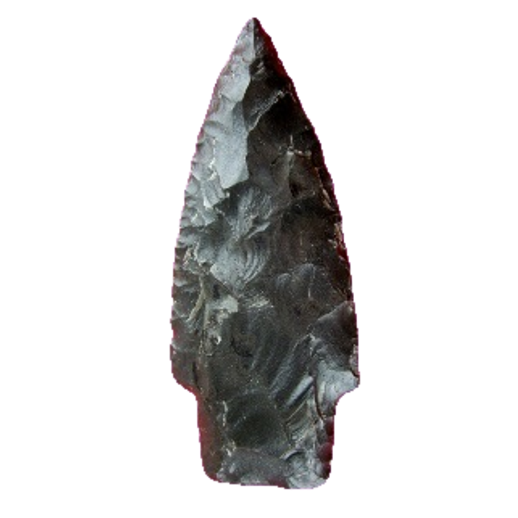
Arrowhead type
Borax Lake Point
Borax LakeBorax Lake Cluster7,600 - 5,000 B.P.Early Archaic to Middle Archaic7 reference photos
Key facts
- Age
- 7,600 - 5,000 B.P.
- Cultural period
- Early Archaic to Middle Archaic
- Size
- Medium
- Shape
- Straight Stem
- Glacial period
- Middle Holocene
More from the Archaic period
Description
This triangular point features a stemmed design with an elliptical profile, exhibiting a blade shape that can range from straight to gently curved outward. Prolonged use and re-sharpening have resulted in a shortened blade length, often yielding a more linear edge. The shoulder morphology varies, spanning from pronounced barbs to nearly horizontal orientations, with re-sharpened specimens typically displaying reduced shoulder definition. The stem itself remains straight, terminating in a straight base. Evidence of basal thinning and grinding is apparent, suggesting deliberate edge refinement. The flaking pattern on this point is characterized by a non-uniform, random arrangement of flakes.
Size
The dimensions of the arrowheads are as follows: they range in overall length from 30 to 85 mm, with stem lengths varying between 11 and 17 mm. The width of the blade spans from 21 to 45 mm, while the stem width measures between 13 and 28 mm. In terms of thickness, the arrowheads are between 6 and 11 mm.
Distribution
This type is mainly discovered in California's Northern Coastal Mountains and the Clear Lake Region. It can also be located in the Sierra Nevada range and the Mojave Desert, as well as adjacent territories
Mainly found in
Additional information
In the realm of Native American arrowhead typology, a distinctive characteristic is used to categorize certain points. Specifically, arrowheads featuring a base with a concave shape are assigned to the Stanislaus point classification. This morphological trait serves as a key diagnostic feature, enabling archaeologists to identify and distinguish Stanislaus points from other types of projectile points. The presence of a concaved base on these points is a consistent and notable characteristic, allowing for a clear and reliable classification within the context of Native American archaeological research.
It is worth noting that the Stanislaus point classification is significant, as it provides valuable insights into the technological and cultural practices of the Native American groups that created these arrowheads. By examining the characteristics of Stanislaus points, researchers can gain a deeper understanding of the historical and geographical contexts in which they were produced and used. Furthermore, the study of Stanislaus points contributes to a broader understanding of the diversity and complexity of Native American cultures, highlighting the importance of continued archaeological research and analysis in this field.
The classification of arrowheads, including those with concaved bases like the Stanislaus point, is crucial for reconstructing the lives and traditions of Native American communities. Through the careful examination and analysis of these artifacts, archaeologists can reconstruct the technological, social, and cultural dynamics of past societies, ultimately enriching our understanding of human history and cultural heritage. By focusing on the unique characteristics of Stanislaus points and other arrowhead types, researchers can continue to refine our knowledge of Native American cultures and their significant contributions to the rich and diverse tapestry of human experience.
Identified by
- Named by
- Mark R. Harrington
- Year
- 1948
- Type site
- Borax Lake Site (CA-LAK-36), Lake County, California
Similar types
Types that are easy to confuse with the Borax Lake point.
- Houx
- Scottsbluff
- Stanislaus
Other types in the Borax Lake Cluster
- Buck Lake
- Mostin