
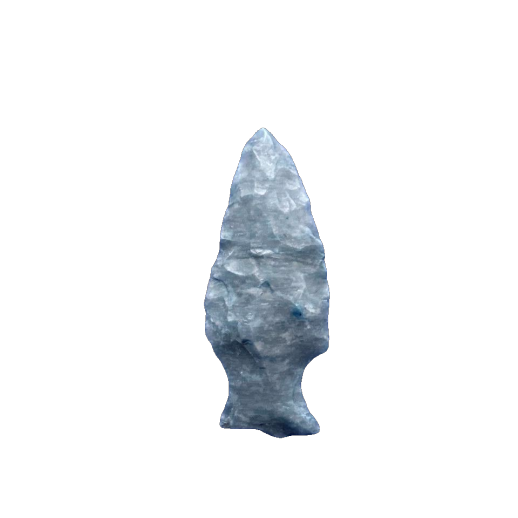
Arrowhead type
Ashtabula Point
AshtabulaSusquehanna Cluster3,500 - 2,500 B.P.Late Archaic to Early Woodland23 reference photos
Key facts
- Age
- 3,500 - 2,500 B.P.
- Cultural period
- Late Archaic to Early Woodland
- Size
- Medium to Large
- Shape
- Expanding Stem
- Material
- Chalcedony
- Glacial period
- Neoglacial
Description
This triangular point exhibits a size range of 4 to 5 inches, characterized by a broad, medium to large profile. Its cross-sectional shape is notably flattened, often trending towards an elliptical form. The blade itself is predominantly straight, although some specimens display a subtle excurvate curvature, while others, having undergone re-sharpening, exhibit an incurvate shape. The shoulders of the point are marked by an upward inclination, frequently presenting an asymmetrical arrangement. The stem's morphology can vary, ranging from nearly straight to distinctly expanding. The base of the point is generally straight, with occasional instances of slight convexity. The flaking pattern observed on this point is random, lacking a discernible, organized arrangement.
Size
The dimensions of the arrowheads are characterized by the following measurements: overall length ranges from 50 to 150 mm, with a typical span of 75 to 100 mm. The stem, a distinct component, measures between 10 and 23 mm in length. In terms of width, the arrowheads exhibit a range of 25 to 50 mm, commonly falling within the narrower range of 25 to 38 mm. Furthermore, the stem width is observed to vary between 12 and 30 mm.
Distribution
This type is mainly located in the northern regions of Ohio, along the upper Ohio River Valley, and extends into southwestern Pennsylvania and western New York. Sightings have also occurred in West Virginia and northwestern Kentucky, albeit less often
Additional information
In the realm of Native American arrowheads, a notable characteristic of this particular point is its elongated and slender stem, distinguishing it from other points within the same cluster. The Ashtabula point type exhibits a range of sizes, with specimens measuring between 4 to 8 inches typically being categorized as knives, given their larger dimensions. Conversely, points with lengths of less than 3 inches are generally classified as projectile points, underscoring the significance of size in determining the functional classification of these artifacts. This size-based distinction highlights the importance of careful measurement and analysis in understanding the roles and uses of various point types within Native American material culture.
The Ashtabula point type is characterized by its unique combination of morphological features, including the aforementioned stem morphology. The size range of 4 to 8 inches for knives and under 3 inches for projectile points provides a useful framework for understanding the technological and functional variability within this point type. By examining the size and shape of these points, archaeologists can gain insights into the activities and needs of the cultures that produced them, as well as the cultural and historical contexts in which they were used.
The classification of Ashtabula points into knives and projectile points based on size has significant implications for our understanding of Native American technological organization and tool use. The presence of both larger, knife-like points and smaller, projectile points within the same cultural context suggests a high degree of flexibility and adaptability in the production and use of stone tools. Furthermore, the standardization of point sizes and shapes within specific cultural traditions highlights the importance of considering the broader cultural and historical contexts in which these artifacts were produced and used.
Identified by
- Named by
- William Mayer-Oakes
- Year
- 1955
Similar types
Types that are easy to confuse with the Ashtabula point.
- Appalachian
- Forest
- Koens Crispin
- Lehigh
- Mansion Inn
- Savannah River
- Schuylkill
- Snook Kill
- Waratan
Other types in the Susquehanna Cluster
- Dismal Swamp
- Dry Brook
- Orient
- Perkiomen
- Susquehanna Broad Spear
- Wayland