
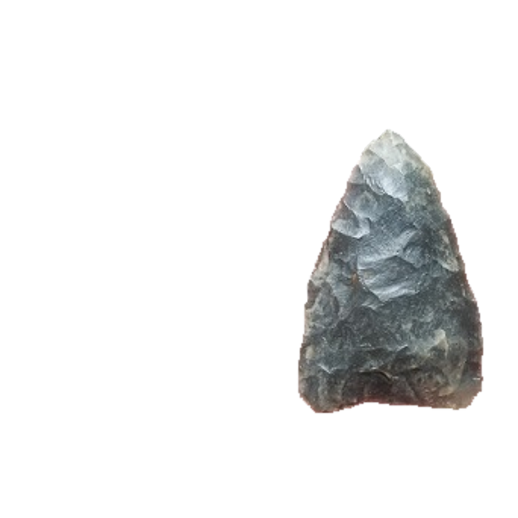
Arrowhead type
Painted Rock Valley Point
Painted Rock ValleyEastern Archaic Triangle Cluster9,500 - 7,000 B.P.Transitional Paleo to Early Archaic3 reference photos
Key facts
- Age
- 9,500 - 7,000 B.P.
- Cultural period
- Transitional Paleo to Early Archaic
- Size
- Medium
- Shape
- Triangle to Lanceolate
- Glacial period
- Early to Middle Holocene
Description
This triangular point exhibits a medium breadth and an elliptical profile, characterized by a distinctive excurvate blade shape that tapers to a concave base. The area where the point would have been attached to a haft is typically marked by either parallel or converging edges. A notable feature of the base is the presence of basal thinning or beveling, which serves to reduce its thickness. The flaking pattern predominantly features parallel oblique removals, often accompanied by finer, secondary flaking on the blade, although some specimens may display a more random flaking arrangement.
Size
The dimensions of these arrowheads are characterized by a total length ranging from 35 to 58 mm, with a mean length of 46 mm. The blade width varies between 25 and 31 mm, averaging 28 mm. The base of the arrowhead measures between 18 and 30 mm in width, with an average of 25 mm. In terms of thickness, the arrowheads exhibit a range of 6 to 10 mm.
Distribution
This type is mainly located in upper Alabama and extends into southwestern Georgia and central Tennessee.
Also found, less often, in
Additional information
The chronological placement of this particular arrowhead type has been a subject of debate among archaeologists. One perspective suggests that it belongs to the Transitional Paleo to Early Archaic period, a classification supported by the distinctive parallel flaking pattern evident on the artifact. Conversely, some researchers argue that this point is more accurately attributed to the Woodland Period, citing the absence of a ground or smoothed hafting region, a characteristic commonly observed in points from this time frame. This discrepancy may stem from the fact that various point types, such as the Conerly and Candy Creek, exhibit overlapping morphological features, including triangular shapes, which can blur the lines between distinct cultural and temporal categories.
A closer examination of the parallel flaking pattern reveals a level of craftsmanship consistent with the Transitional Paleo to Early Archaic period, which spanned from approximately 10,000 to 8,000 years ago. The lack of hafting region modification, on the other hand, is a trait more commonly associated with Woodland Period points, which date to around 1,000 to 1,500 years ago. The coexistence of these characteristics has led to the confusion surrounding the typological classification of this arrowhead. Further study and comparison with other artifacts from well-dated contexts are necessary to resolve this issue and provide a more precise understanding of the cultural and temporal affiliations of this enigmatic point type.
The Conerly, Candy Creek, and other triangular point types, which exhibit similar morphological features, may hold the key to resolving the controversy surrounding the dating of this arrowhead. A comprehensive analysis of these related types, including their technological, stylistic, and distributional characteristics, could provide valuable insights into the cultural and historical context in which this point was produced. By examining the overlapping features and differences between these point types, archaeologists may be able to develop a more nuanced understanding of the technological and cultural developments that occurred during the Transitional Paleo to Early Archaic and Woodland Periods, ultimately shedding light on the significance and origins of this intriguing arrowhead type.
Identified by
- Named by
- E. C. Mahan
- Year
- 1955
- Type site
- Paint Rock Valley Site, Jackson County, Alabama
Similar types
Types that are easy to confuse with the Painted Rock Valley point.