

Named stone
Onondaga chert
Also called Onondaga Limestone chert, Divers Lake chert (the lustrous western New York variety), Eastern, central and western Onondaga chert (Funk's varieties)
A kind of chert (and flint)
Onondaga chertChert (and flint)NortheastDescription
Onondaga chert is the chert of the Middle Devonian Onondaga Limestone, which runs across southern New York, southwestern Ontario and northern Pennsylvania. It was the leading toolstone of prehistoric New York and is common in neighbouring states and provinces. Colour runs from light gray to nearly black, with tan and blue-tinted pieces, and the texture is smooth and waxy. The chert is richest in the Clarence (Nedrow) member, where it can make up more than half of the rock by weight. Quality varies a lot: some outcrops are full of flaws, others flake with a clean conchoidal break. Pieces from different outcrops look alike, so colour alone cannot name the source, although the lustrous, brightly mottled western Divers Lake stone differs from the duller eastern kind.
How to identify it
- Colour
- Light gray to grayish black (Munsell N6 to N2) in the Niagara Frontier outcrops (Jarvis); eastern Onondaga is dark brownish blue to bluish black, central is cloudy dark to brownish blue, and western is tan, khaki, light gray to milky bluish white, with mottled, cloudy colours (Funk, quoting earlier workers).
- Texture
- Smooth and waxy and generally fine grained; Jarvis found it macroscopically homogeneous. Quality ranges from flawed, unusable stone to even texture with an excellent conchoidal fracture.
- Luster
- Eastern variety relatively dull and uniform; the western 'Divers Lake' variety has a lustrous surface and brighter blue, brown and gray mottles (Funk).
- Inclusions
- Dolomite crystals are common and pyrite is always present; well-preserved brachiopod, coral, crinoid and bryozoan fossils are often seen, and fibrous chalcedony occurs as veinlets, seams and spherules (Funk).
Geology
Middle Devonian Onondaga Limestone, in four members from oldest to youngest: Edgecliff, Clarence (called Nedrow in eastern New York), Seneca and Moorehouse. Chert is extremely common in the Clarence member (often over 50 percent by mass), averages under 5 percent in the Edgecliff, and falls in between in the Seneca and Moorehouse. The formation underlies the southern half of New York State and reaches southwestern Ontario and northern Pennsylvania. Along the Onondaga Escarpment of western New York chert is abundant, east of Rochester it becomes scarce, and east of Syracuse it is plentiful again.
Where it comes from
Northeast
States
Quarries and outcrops
- Onondaga Escarpment, western New York (Buffalo east to Akron)
- Divers Lake quarry area, western New York (native quarries and workshops west of the New York State Thruway)
- Outcrops in southwestern Ontario and northern Pennsylvania (outside the New York core)
Used by
- Paleoindian: fluted points of western Onondaga chert occur in the Hudson Valley at West Athens Hill, where Normanskill chert was preferred (Funk)
- Late Archaic to Early Woodland: Onondaga chert from the New York/Ontario area appears in Saginaw Valley, Michigan, near the end of the Late Archaic and continues into the Meadowood phase from about 700 B.C. (Castle Museum, Saginaw)
Look-alikes
Stones that are easy to confuse with Onondaga chert.
- Helderberg group cherts of eastern New York (Kalkberg, New Scotland, Becraft, Alsen): dark, dull and fine grained; Funk notes dark cherts of the area are easily confused
- Normanskill (Mount Merino) chert: dark gray to black varieties
- Other Devonian cherts of eastern New York such as Glenerie, Esopus and Oriskany (Funk's appendix)
Sources
- Funk, Robert E. 2004. An Ice Age Quarry-Workshop: The West Athens Hill Site Revisited. New York State Museum Bulletin 504. University of the State of New York, Albany.exhibitions.nysm.nysed.gov (opens in a new tab)
- Jarvis, Hugh W. 1989. Instrumental Neutron Activation Analysis of Onondaga Chert in the Niagara Frontier. Ontario Archaeology 51.ontarioarchaeology.org (opens in a new tab)
- Castle Museum of Saginaw County. Saginaw Valley Archaeology.castlemuseum.org (opens in a new tab)
Points made from this stone
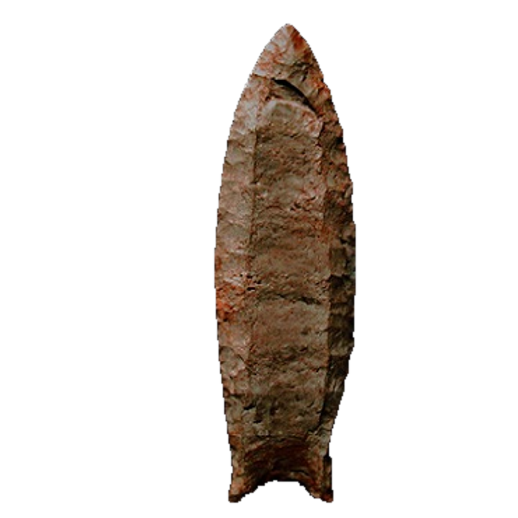 BarnesLate Paleo11,000 - 9,000 B.P.
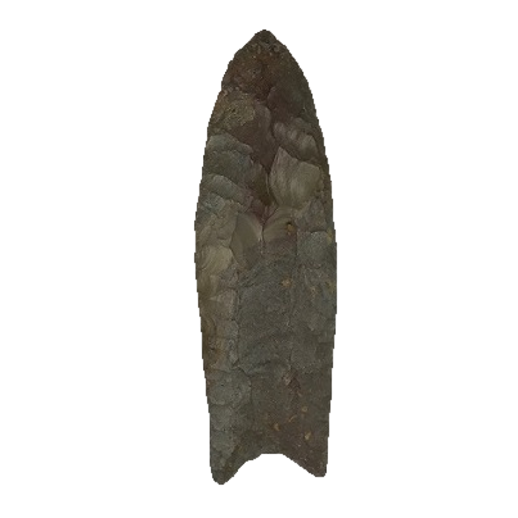 Gainey FlutedMiddle PaleoindianSlightly younger than Clovis. The type site has no radiocarbon dates; one sample from the Gainey horizon at the Big Eddy site, Missouri, gave 10,710 +/- 85 radiocarbon years B.P. (about 12,700 calendar years ago).
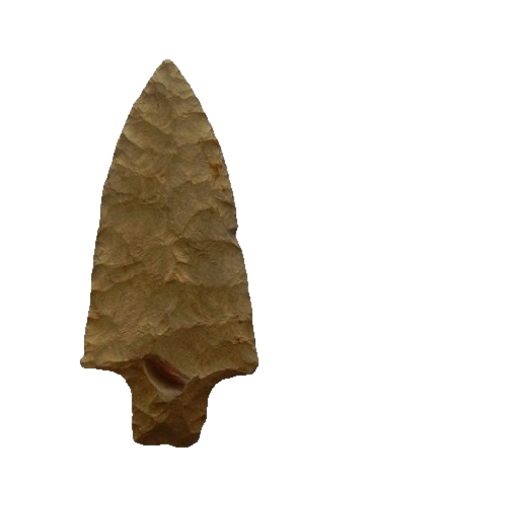 GeneseeLate ArchaicAbout 3,950–3,200 B.P. in central New York (Frontenac phase about 2000 B.C.; Frost Island level at the O'Neil site dated 1250 B.C. ± 100; Ritchie 1971); 4,950–3,650 B.P. (3,000–1,700 B.C.) on an Indiana chart (Jones and Johnson 2003)
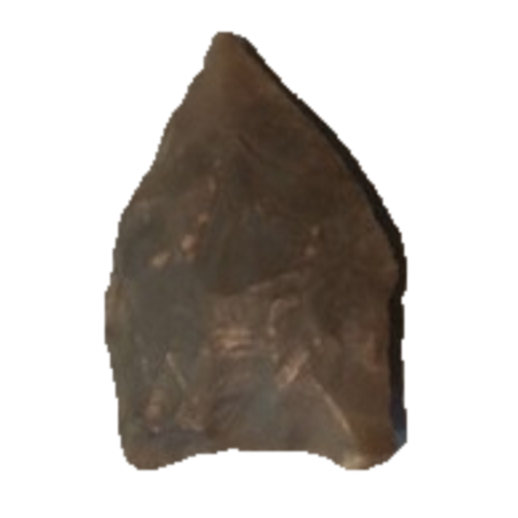 Hi - LoLate Paleoindian10,500 - 10,000 B.P.
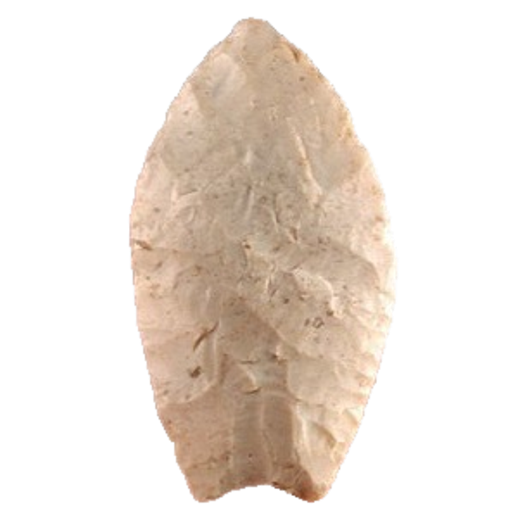 Holcombe FlutedLate Paleoindian10,500 - 10,000 B.P.
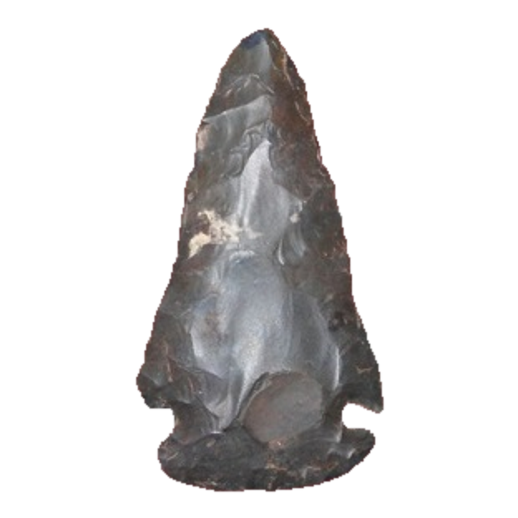 MeadowoodEarly WoodlandAbout 3,000–2,500 B.P. (Chartier 2011); radiocarbon dates from about 998 B.C. in New York to 520 B.C. at the Bruce Boyd site, Ontario (OAS London Chapter)