
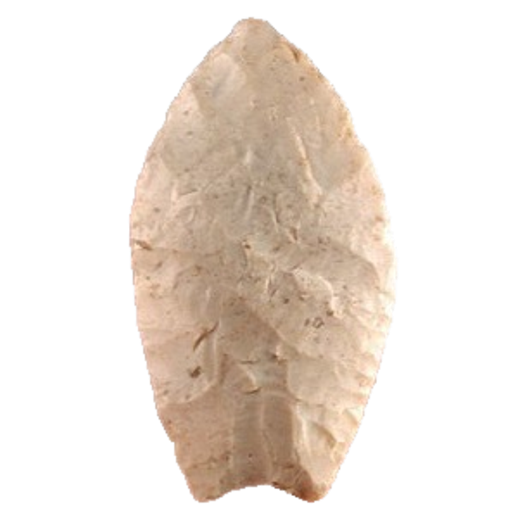
Arrowhead type
Holcombe Fluted Point
Holcombe FlutedClovis Cluster10,500 - 10,000 B.P.Late Paleo5 reference photos
Key facts
- Age
- 10,500 - 10,000 B.P.
- Cultural period
- Late Paleo
- Size
- Small to Medium
- Shape
- Lanceolate
- Material
- Chert
- Glacial period
- Late Pleistocene
More from the Paleo period
Description
This lanceolate point exhibits a slender profile, characterized by a flattened cross-sectional morphology. The blade's curvature is pronounced, with a broad, excurvate shape that tapers inward toward the base, forming a distinctive constriction. Notably, the base of this point is narrower than that of other Clovis variants, with the maximum blade width typically occurring at or above the midpoint. The basal area is concave, often featuring sharp, slender basal ears, and lacks the characteristic "fishtail" morphology. Many examples display light to heavy grinding along the basal and lateral edges. Fluting is commonly present on one face, with the flute's length often approximating the basal width. However, in exceptionally thin specimens where the base is already sufficiently narrow for hafting, fluting may be absent. The flaking pattern on these points can exhibit a range of variations, including random, collateral, or parallel transverse patterns, highlighting the diversity of technological approaches employed in their manufacture.
Size
The arrowheads exhibit the following dimensional characteristics: their length ranges from 34 to 70 mm, with a mean length of 51.6 mm. The maximum blade width varies between 16 and 28 mm, averaging 21.6 mm. The basal width spans from 13 to 27 mm, with a mean of 18.8 mm. Notably, the basal concavity is limited to 5 mm or less. The length of basal thinning flakes falls within the range of 4 to 29 mm, with a mean of 14.9 mm. Lastly, the thickness of the arrowheads measures between 3 and 7 mm, with a mean thickness of 4.9 mm.
Distribution
This type is mainly discovered in Michigan and the surrounding Great Lakes area
Additional information
In contrast to Crowfield points, which often exhibit a distinctive shoulder or pentagonal shape, these arrowheads are characterized by a more streamlined appearance. Notably, they tend to be thinner than their Crowfield counterparts, with a key distinguishing feature being the presence of more extensive fluting, as observed in specimens classified as W14. The evolutionary trajectory of this point type is believed to have originated from the earlier Crowfield point, specifically the W2 variant, suggesting a developmental progression from one form to the other. This transition is significant, as it highlights the dynamic nature of technological innovation and cultural exchange within the context of Native American arrowhead production.
The thinner profile and increased fluting of these points may indicate a refinement in manufacturing techniques, allowing for more efficient hunting practices and potentially reflecting adaptations to specific environmental or prey-related factors. Furthermore, the absence of a shoulder or pentagonal shape in these points underscores the diversity of design elements present in Native American arrowhead typology, with different cultures and regions often exhibiting unique stylistic and functional preferences.
The relationship between these points and the earlier Crowfield type, particularly the W2 variant, underscores the importance of considering the diachronic development of arrowhead styles, where the evolution of forms can provide valuable insights into the technological, social, and cultural dynamics of past societies. By examining the morphological and metric characteristics of these points, researchers can gain a deeper understanding of the complex historical contexts in which they were created and used, ultimately enriching our appreciation of Native American cultural heritage and the significance of arrowheads as artifacts of enduring importance.
Identified by
- Named by
- James E Fitting
- Year
- 1966
- Type site
- Holcombe Site (Holcombe Beach), Macomb County, Michigan
Similar types
Types that are easy to confuse with the Holcombe Fluted point.
- Angostura
- Beaver Lake
- Crowfield
- Cumberland
- Dalton
- Debert
- Northumberland
Other types in the Clovis Cluster
- Clovis
- Clovis Hazel
- Clovis St. Louis
- Clovis Tulare Lake
- Clovis Un-fluted
- Redstone