
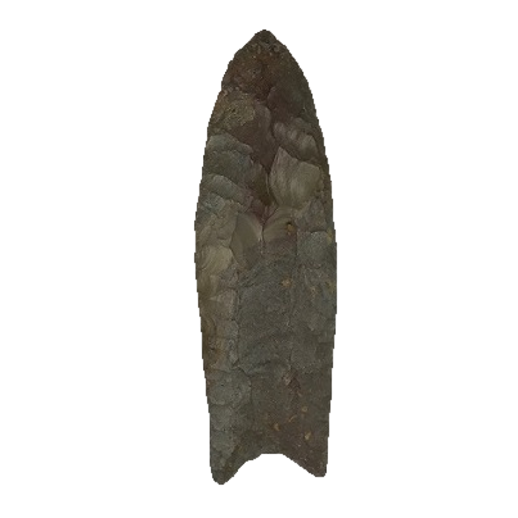
Arrowhead type
Gainey Fluted Point
Gainey FlutedClovis Cluster12,500 - 10,000 B.P.Late Paleo9 reference photos
Key facts
- Age
- 12,500 - 10,000 B.P.
- Cultural period
- Late Paleo
- Size
- Medium to Large
- Shape
- Auriculate to Lanceolate
- Material
- Flint
- Glacial period
- Late Pleistocene
More from the Paleo period
Description
This lanceolate fluted point measures between 2.25 and 3.75 inches in length, exhibiting a distinctive morphology. Notably, its width and thickness are proportionally substantial, with a width-to-thickness ratio of 3-4 to 1. A characteristic feature of this point is its relatively thin profile between the flutes, setting it apart from other Clovis points. The cross-sectional shape is flattened, a result of the fluting process. The blade's excurvate shape is marked by an inward-curving tip and parallel edges, with a possible subtle contraction towards the base, although it lacks a constricted waist or "fishtail" silhouette.
The fluting platform on this point type bears a resemblance to those found on Folsom and Cumberland points, with each face potentially featuring one or multiple flutes. These flutes typically extend halfway to two-thirds up the face, often without the characteristic step or hinge fracture termination. The use of pressure flaking to remove the platform has created a pronounced basal concavity, achieved through the Barnes Finishing Technique. In heavily resharpened specimens, the point may assume a morphology similar to that of a Folsom point. Evidence of grinding is visible on the basal and hafting areas. The flaking pattern on this point can vary, ranging from random to collateral or transverse flaking, showcasing the versatility of the manufacturing technique.
Size
The dimensions of the arrowheads are as follows: they range in length from 51 to 127 mm, with a mean length of 68.4 mm. In terms of width, they measure between 20 and 37 mm, averaging 26.9 mm. The thickness of the arrowheads varies from 6 to 8.5 mm, with a mean thickness of 7.6 mm. The basal width ranges from 19 to 32 mm, with an average of 26.1 mm. Additionally, the basal concavity measures between 2.8 and 8.5 mm, with a mean of 4.9 mm.
Distribution
This projectile is mainly discovered in the northeastern quadrant of North America, encompassing southern Ontario, eastern Michigan, northern Ohio, Wisconsin, and extending into western Pennsylvania and western New York. This projectile has also been identified in the Mississippi River Valley, albeit with lesser regularity.
Mainly found in
Also found, less often, in
Additional information
In the realm of Paleoindian archaeology, the Barnes Finishing Technique stands out as a distinctive basal treatment characterized by the deliberate widening and thinning of the base of the flute, achieved through the removal of a single short, broad flake. Initially, this type was mistakenly identified as Bull Brook points by Roosa in 1964, but subsequent research revealed that it constitutes a separate entity, unrelated to the northern distribution of the Bull Brook type, designated as W14. Notably, the Barnes Type is regarded as the earliest Paleoindian point type discovered in Michigan, marking a significant milestone in the state's archaeological record.
A closer examination of the Barnes Type reveals a notable progression in flaking techniques, which is often absent in its predecessor, the Gainey type. As observed by Simons in 1984, the advanced flaking methods employed in the Barnes Type suggest a temporal succession, with the Barnes Type emerging after the Gainey type. This sequence is supported by the presence of more sophisticated flaking techniques on Barnes Type points, which are generally lacking on Gainey type points. The Barnes Type's refined flaking characteristics imply a higher level of technological sophistication, underscoring the importance of this type in the Paleoindian archaeological record.
The Barnes Type's significance extends beyond its technological advancements, as it provides valuable insights into the cultural and chronological context of Michigan's early inhabitants. As the earliest Paleoindian point type in the region, the Barnes Type offers a unique window into the lives of the state's first human occupants, shedding light on their technological, social, and cultural developments. By examining the characteristics and distribution of the Barnes Type, researchers can gain a deeper understanding of the complex and dynamic history of Native American cultures in the region, ultimately enriching our appreciation of the rich and diverse archaeological heritage of Michigan.
Identified by
- Named by
- Don Simons
- Year
- 1984
- Type site
- Gainey Site, Genesee County, Michigan
Similar types
Types that are easy to confuse with the Gainey Fluted point.