Rock type
Obsidian
Also called Volcanic glass, Natural glass
Obsidianobsidian (volcanic glass)All regions2 photos
Description
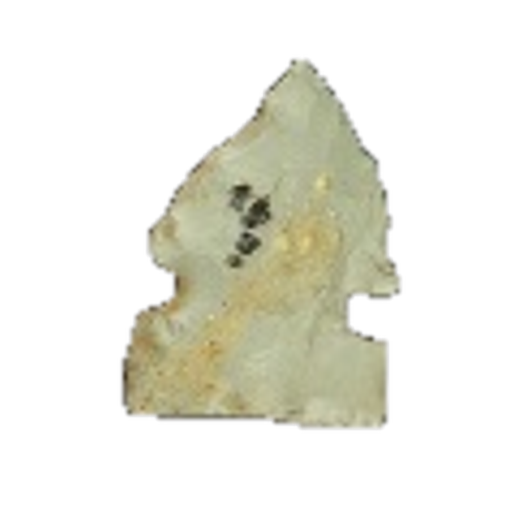
Obsidian is natural volcanic glass, formed when lava, usually rhyolite, cools too fast for crystals to grow. It is typically black, but red, brown, green and clear pieces occur, and banding or a reflective sheen sometimes shows. It breaks with a very sharp conchoidal edge. Researchers use X-ray fluorescence to trace artifacts to their source, and Oregon alone has more than 100 geochemical sources. Because the source matters, obsidian pages here are by source. Obsidian Cliff in Yellowstone is the most widely traded: its glass reached Ohio Hopewell sites about 1,800 years ago. Glass Buttes in Oregon was used for at least 14,000 years.
How to identify it
- Colour
- Typically black; sometimes clear, greenish or reddish (Bakken); red, brown or green hues come from the oxidation state of iron minerals; banding from oxidised flow surfaces folded into the lava (Ozbun).
- Texture
- Non-crystalline glass (holohyaline), without grains.
- Luster
- Glassy; stretched gas bubbles can give a reflective sheen or cat's-eye effect.
- Inclusions
- A tiny amount of finely dispersed magnetite gives the black colour.
Geology
Obsidian is the glassy texture of volcanic rock cooled too quickly to crystallise, and it can be basaltic, andesitic, dacitic or rhyolitic depending on silica. The most common kind is rhyolitic obsidian (68 to 77 percent silica) from viscous lava flows and domes. Basaltic glass, tachylyte, forms thin rinds on basalt flows. Obsidian also occurs in pyroclastic ash flows. Obsidian Cliff in Yellowstone is a 98-foot-thick exposure of glass; Glass Buttes is a large rhyolitic volcanic center about five million years old in south-central Oregon.
Where it comes from
All regions
Quarries and outcrops
- Obsidian Cliff, Yellowstone National Park, Wyoming (more than 11,000 years of quarrying; National Historic Landmark 1996)
- Glass Buttes, Lake County, Oregon (nine geochemical varieties; used for at least 14,000 years)
- Obsidian sources of the Great Basin, such as those in Nevada and California listed by the Nevada Department of Transportation project
Used by
- Obsidian Cliff was first quarried more than 11,000 years ago, and its glass reached Ohio Hopewell sites about 1,850 to 1,750 years ago (NPS)
- Glass Buttes: at least fourteen millennia of use (Stueber and Skinner)
Look-alikes
Stones that are easy to confuse with Obsidian.
- Basaltic glass (tachylyte) and glass in ash-flow tuffs, which are glassy but not rhyolitic obsidian (Ozbun)
- Fine-grained rhyolite (aphanitic, not glassy)
Sources
- Ozbun, Terry L. 2015. Toolstone Geography and the Larger Lithic Landscape. Chapter 1 in Toolstone Geography of the Pacific Northwest. Archaeology Press, Simon Fraser University.archpress.lib.sfu.ca (opens in a new tab)
- Stueber, Daniel O., and Craig E. Skinner. 2015. Glass Buttes, Oregon: 14,000 Years of Continuous Use. Chapter 12 in Toolstone Geography of the Pacific Northwest. Archaeology Press, Simon Fraser University.archpress.lib.sfu.ca (opens in a new tab)
- National Park Service. Obsidian Cliff. Yellowstone National Park.nps.gov (opens in a new tab)
- Moore, Joe. 2009. Great Basin Tool-Stone Sources: The NDOT Obsidian and Tool-Stone Sourcing Project, 2002 Progress Report. Nevada Department of Transportation, Carson City.deschutesmeridian.com (opens in a new tab)
- Bakken, Kent E. (written about 1995; PDF issued later). Chipped Stone Raw Materials. Chapter 6 in Stone Tools of Minnesota. Minnesota Office of the State Archaeologist, St. Paul.mn.gov (opens in a new tab)
Named stones of this kind
- Batza Tena obsidianobsidianAlaska
- Bear Gulch obsidianobsidian (sintered vitric ash pyroclasts)Idaho
- Big Southern Butte obsidianobsidian (peralkaline rhyolite dome)Idaho
- Bodie Hills obsidianobsidianCalifornia
- Borax Lake obsidianobsidianCalifornia
- Browns Bench obsidianobsidian (ash-flow tuff glass)Nevada, Idaho, Utah and more
- Casa Diablo obsidianobsidian (rhyolite flow glass)California
- Cerro del Medio obsidianobsidian (rhyolite dome glass)New Mexico
- Cerro Toledo obsidianobsidian (rhyolite tephra glass)New Mexico
- Coso Volcanic Field obsidianobsidianCalifornia
- El Rechuelos obsidianobsidian (rhyolite dome glass)New Mexico
- Elk Pass obsidianobsidianWashington
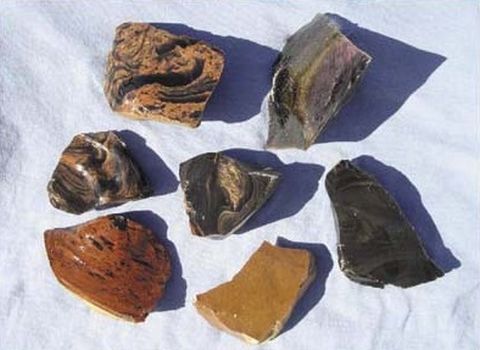 Glass Buttes obsidianobsidian (rhyolitic volcanic center)Oregon
- Government Mountain obsidianobsidian (rhyolite dome glass)Arizona
- Malad obsidianobsidian (banded pyroclasts in pumice)Idaho
- Manning fused glassnatural glass (volcanic ash fused by burning lignite)Texas
 Medicine Lake Highland obsidianobsidian (rhyolite flows)California
- Modena and Panaca Summit obsidianobsidian (nodules in perlite and float)Utah, Nevada
- Mount Taylor obsidianobsidian (rhyolite glass)New Mexico
- Mule Creek obsidianobsidian (marekanite nodules in perlitic rhyolite)New Mexico, Arizona
- Napa Glass Mountain obsidianobsidianCalifornia
 Newberry Volcano obsidianobsidian (flow glass)Oregon
 Obsidian Cliff obsidianobsidian (volcanic glass)Wyoming
- Obsidian Cliffs obsidian (Oregon Cascades)obsidian (dacite and rhyodacite glass)Oregon
 Superior obsidianobsidian (marekanite nodules in perlite)Arizona
- Timber Butte obsidianobsidian (intrusive rhyolite dome glass)Idaho
- Topaz Mountain obsidianobsidianUtah
- Tuscan obsidianobsidian (glass blocks in volcanic mudflow rock)California
- Vulture obsidianobsidian (marekanite nodules in perlite and tuff)Arizona
- Wildhorse Canyon obsidianobsidianUtah