Named stone
El Rechuelos obsidian
Also called El Rechuelos Rhyolite obsidian, Polvadera Peak obsidian (a misnomer)
A kind of obsidian
El Rechuelos obsidianObsidianTexas & SouthwestDescription
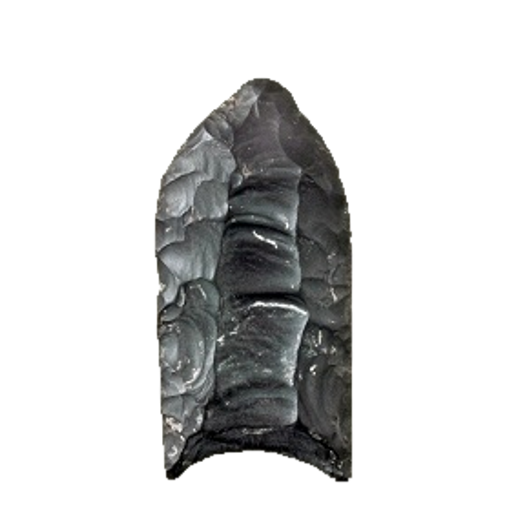
El Rechuelos obsidian comes from a few small rhyolite domes north of Polvadera Peak in the Jemez Mountains. It is often wrongly called Polvadera Peak obsidian, but Polvadera Peak itself is a dacite dome that produced no artifact-quality glass. The glass is aphyric and uniformly granular, which makes it easy to recognise, and it is one of the best toolstones in the Jemez. Of about 500 nodules checked, few had spherulites or crystals. Nodules reach 15 cm but most are 1 to 5 cm. A 1974 report on Cerro Pedernal says a smoky gray obsidian from the Polvadera Peak area was used heavily by early peoples, often alongside Pedernal chert at Archaic sites. Cody-complex groups used El Rechuelos more than other Jemez glass.
How to identify it
- Colour
- Smoky gray in the Polvadera Peak area, per Warren (1974).
- Texture
- Uniformly granular in character; aphyric; few spherulites or phenocrysts (Shackley).
- Inclusions
- Few spherulites or crystals.
Geology
Rhyolite domes of the El Rechuelos Rhyolite, north of Polvadera Peak, Jemez Mountains. Three small coalesced domes, each about 50 m across, carry ashy lava with obsidian nodules; small nodules wash into Canada de los Ojitos and the Rio Grande gravels. Obsidian from this source is not spread over a large area.
Where it comes from
Texas & Southwest
States
Quarries and outcrops
- Domes at the head of Canada de los Ojitos, north of Polvadera Peak, Jemez Mountains
Used by
- Clovis: two El Rechuelos artifacts from Socorro and Catron counties (Hamilton and others 2009)
- Cody complex: the most-used Jemez source in 27 sourced Cody artifacts (12 of 27; LeTourneau and Shackley, as cited by Dolan and others)
- Archaic: with Pedernal chert at many sites near Cerro Pedernal (Warren 1974)
Look-alikes
Stones that are easy to confuse with El Rechuelos obsidian.
- Cerro Toledo and Valles Rhyolite obsidian (the other two main Jemez glasses, which often have spherulites)
Sources
- Shackley, M. Steven. Geoarchaeological XRF Laboratory, University of California, Berkeley. Southwestern obsidian source description: Jemez Mountains and the Sierra de los Valles.swxrflab.net (opens in a new tab)
- Warren, A. Helene. 1974. The ancient mineral industries of Cerro Pedernal, Rio Arriba County, New Mexico. NMGS Guidebook 25, pp. 87-93.nmgs.nmt.edu (opens in a new tab)
- Dolan, Sean G., Judy Berryman, and M. Steven Shackley. 2016. The Source Provenance of an Obsidian Eden Point from Sierra County, New Mexico. PaleoAmerica (accepted manuscript, Los Alamos National Laboratory LA-UR-15-28702). https://doi.org/10.1080/20555563.2016.1138822osti.gov (opens in a new tab)
- Hamilton, Marcus J., Bruce B. Huckell, and M. Steven Shackley. 2009. Clovis Obsidian Sources in the Central Rio Grande Rift Region of New Mexico. Current Research in the Pleistocene 26:62-65.unm.edu (opens in a new tab)