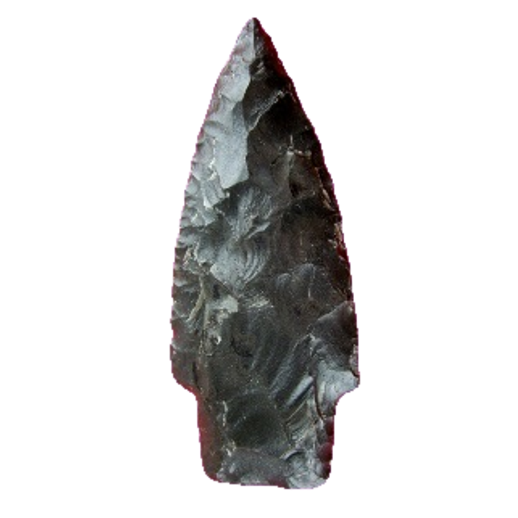
Named stone
Borax Lake obsidian
Also called Borax Lake obsidian source (Lake County)
A kind of obsidian
Borax Lake obsidianObsidianWest Coast & PlateauDescription
Borax Lake obsidian is named for the Borax Lake site (CA-LAK-36) beside Clear Lake in Lake County, in the North Coast Ranges of California. The site is famous because Harrington's 1940s excavation recovered fluted points that are now read as Clovis-like in size and shape, and most are made of obsidian, unlike most Clovis points elsewhere. Archaeologists later recognised a long series of occupations there, and obsidian hydration dating was used to sort out the early artifacts. The Borax Lake Pattern is the northern California version of the Western Stemmed tradition, and Borax Lake wide-stemmed points in Colusa County foothill sites are made mostly of Borax Lake obsidian, with some Napa Valley, Mount Konocti and Medicine Lake glass.
Geology
Obsidian of the Clear Lake area in the North Coast Ranges. The opened sources are archaeology papers and give no geology or look of the glass.
Where it comes from
West Coast & Plateau
States
Quarries and outcrops
- Borax Lake site (CA-LAK-36) and the Clear Lake volcanic area, Lake County
Used by
- Early occupation at the Borax Lake site: fluted points and crescents are the oldest artifacts; Post Pattern basement complex (Meighan 1986)
- Borax Lake Pattern (Northern California Western Stemmed tradition), Lower Archaic: wide-stemmed points; hydration ages of about 4,500 to 8,000 years ago at Colusa County sites (White and others 2009)
Look-alikes
Stones that are easy to confuse with Borax Lake obsidian.
- Napa Valley, Mount Konocti and Medicine Lake obsidians (found together in Colusa County sites)
Sources
- Meighan, Clement W. 1986. Review of the Borax Lake Site (CA-LAK-36). Archives of California Prehistory 6:55-57, Coyote Press.californiaprehistory.com (opens in a new tab)
- White, Gregory G., and others. 2009. Sites Reservoir Archaeological Inventory Report: cultural setting (Appendix 22A, Sites Project RDEIR/SDEIS). Archaeological Research Program, California State University, Chico.sitesproject.org (opens in a new tab)