Named stone
Cerro del Medio obsidian
Also called Valles Rhyolite obsidian, Valles Caldera obsidian
A kind of obsidian
Cerro del Medio obsidianObsidianTexas & SouthwestDescription
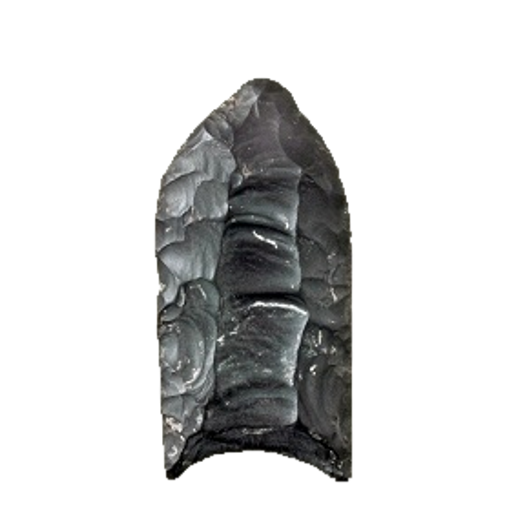
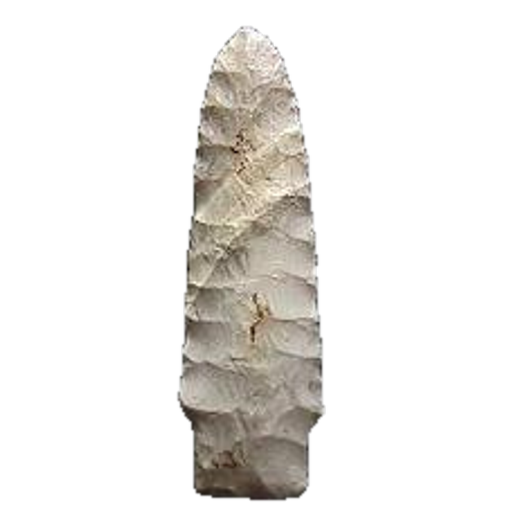
Cerro del Medio is a rhyolite dome complex inside the Valles Caldera in the Jemez Mountains of northern New Mexico, and its glass is the Valles Rhyolite obsidian of the source lists. The caldera was visited seasonally for more than 10,000 years and obsidian was mined at Cerro del Medio. The glass is mostly black and nearly free of crystals, with a granular fabric in places and devitrified spherulites in others, so quality sits between Cerro Toledo and El Rechuelos. One west-slope outcrop has artifact-quality mahogany glass. Unlike the other Jemez sources, this obsidian has not washed into the Rio Grande in useful sizes, so artifacts made of it mean someone went into the caldera or traded for it. A Cody-complex Eden point found about 280 km south was chemically sourced here.
How to identify it
- Colour
- Much of it aphyric black; an outcrop on the west slope of Cerro del Medio is artifact-quality mahogany-coloured glass with the same chemistry (Shackley).
- Texture
- Granular like El Rechuelos in places; elsewhere devitrified spherulites like Cerro Toledo. Quality is intermediate between Cerro Toledo and El Rechuelos (Dolan and others).
- Inclusions
- Devitrified spherulites in some pieces, which lower knapping quality.
Geology
Obsidian flows of the Valles Rhyolite within the Valles Caldera, Jemez Mountains: massive, almost crystal-free obsidian flows dated at about 1.17 to 1.23 million years in the geologic map. The geologic map names obsidian flows here as the source of many artifacts. The glass is found as nodules up to about 15 cm in the caldera; it is the only Jemez obsidian that has not eroded into the Rio Grande gravels in any appreciable size.
Where it comes from
Texas & Southwest
States
Quarries and outcrops
- Cerro del Medio dome, Valles Caldera, Jemez Mountains, northern New Mexico
- San Antonio Creek headwaters inside the caldera (secondary nodules up to 15.5 cm)
Used by
- Paleo-Indian, Archaic and ancestral Puebloan visits to the caldera over more than 10,000 years (Goff and others)
- Clovis: Valles rhyolite obsidian in two artifacts from the Mockingbird Gap site (Hamilton and others 2009)
- Cody complex: an obsidian Eden point from Sierra County matched Cerro del Medio (Dolan and others 2016); Cody-complex artifacts sourced here are fewer than those from El Rechuelos
Look-alikes
Stones that are easy to confuse with Cerro del Medio obsidian.
- Cerro Toledo and El Rechuelos obsidian (flakes can be indistinguishable in hand sample)
Sources
- Shackley, M. Steven. Geoarchaeological XRF Laboratory, University of California, Berkeley. Southwestern obsidian source description: Jemez Mountains and the Sierra de los Valles.swxrflab.net (opens in a new tab)
- Dolan, Sean G., Judy Berryman, and M. Steven Shackley. 2016. The Source Provenance of an Obsidian Eden Point from Sierra County, New Mexico. PaleoAmerica (accepted manuscript, Los Alamos National Laboratory LA-UR-15-28702). https://doi.org/10.1080/20555563.2016.1138822osti.gov (opens in a new tab)
- Goff, Fraser, and others. 2011. Geologic Map of the Valles Caldera, Jemez Mountains, New Mexico (Geologic Map 79 booklet). New Mexico Bureau of Geology and Mineral Resources.geoinfo.nmt.edu (opens in a new tab)